
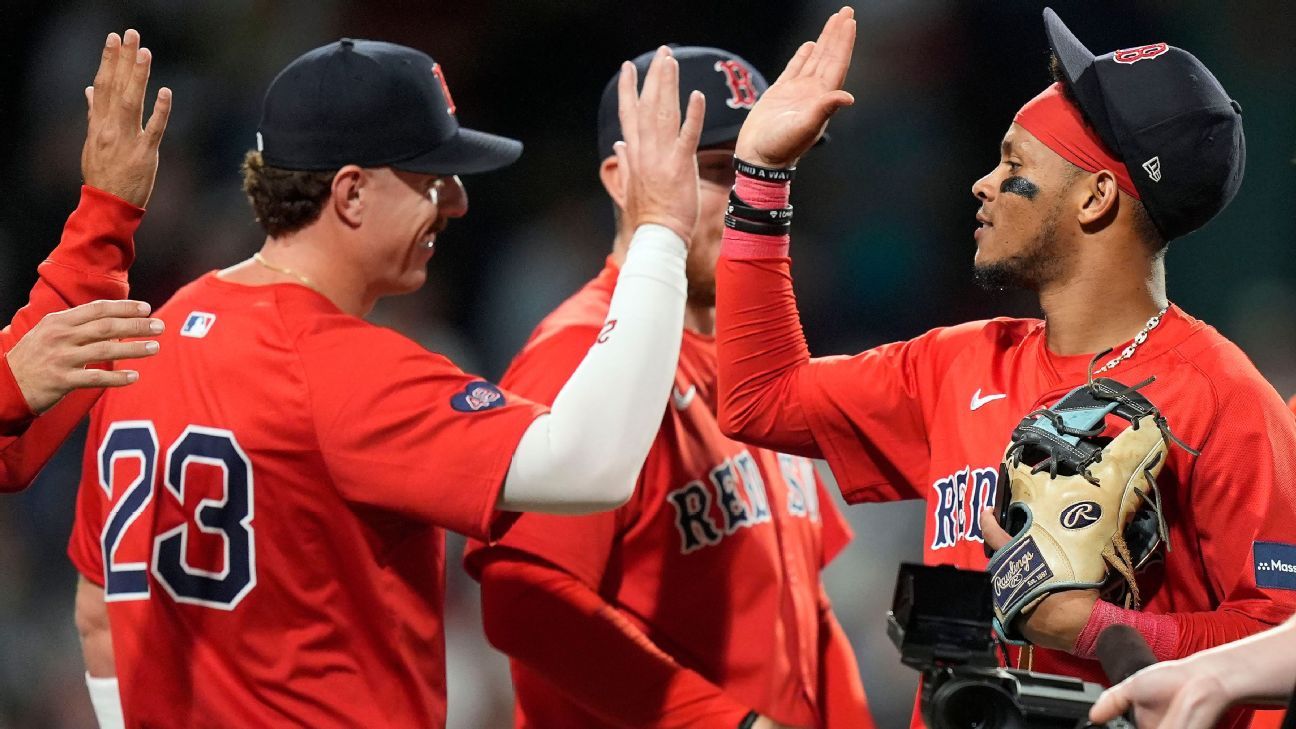
2025 MLB predictions: From playoffs and World Series to MVPs and Cy Youngs


MLB’s regular season gets underway tomorrow with Opening Day baseball, so you know what that means — it’s time for season predictions!
There are lots of questions going into the 2025 season: Will the Dodgers repeat as World Series champions? What surprises will the expanded playoffs bring this year? How will Juan Soto look for the Mets — and how will the Yankees fare without him? And when will we see Shohei Ohtani reprise his two-way role on the mound?
No one can definitively know what’s in store for this season, but that doesn’t stop us from making our best guesses. We put 28 of ESPN’s MLB writers, analysts and editors on the spot to predict what will happen in baseball this year, from the wild-card contenders all the way up to the World Series champion, plus the MVP, Cy Young and Rookie of the Year awards in both leagues.
For each category, we’ve asked a number of our voters to explain their picks. Did they hit the nail on the head or were they way off their mark? Only time can tell — and we’ll be circling back to these predictions come October to see how well — or poorly — we did.
Jump to:
AL picks | NL picks | WS picks | AL awards | NL awards
AL East

Our pick: Boston Red Sox (13 votes)
Who else got votes? Baltimore Orioles (10), New York Yankees (3), Toronto Blue Jays (1), Tampa Bay Rays (1)
Boston is our voters’ favorite in the AL East. How can the Orioles beat out the Red Sox for the title? The Orioles will win the division because they will cobble together enough pitching to outlast the Red Sox and Yankees. They will win because their young players — most prominently Adley Rutschman, Gunnar Henderson and Colton Cowser — will carry the offense through the regular season. Jackson Holliday, free of last year’s ridiculous expectations, will be more relaxed and productive. And here’s a wild card: Tomoyuki Sugano, signed out of Japan, will be a revelation in the starting rotation and present a reasonable facsimile of the departed Corbin Burnes. But temper the excitement: Boston is my pick to end up in the World Series. — Tim Keown
You were the only person to pick Toronto to win the division. Why are the Jays your choice? The Yankees and Orioles are already going to be several wins worse than last season because of all of those injuries they’ve already suffered this spring. Meanwhile, Vladimir Guerrero Jr. is playing for a new contract, Bo Bichette can’t possibly play as poorly as he did last season and Anthony Santander gives this lineup a nice power upgrade. If even only one of Max Scherzer and Jeff Hoffman stays healthy into September, we’re looking at a potential division winner here. Throw in a little extra support from an extra-motivated Canadian fan base? Head and heart unite behind the Blue Jays in 2025. — AJ Mass
AL Central

Our pick: Kansas City Royals (12 votes)
Who else got votes? Detroit Tigers (11), Minnesota Twins (4), Cleveland Guardians (1)
Make the case for the Royals to take home the division title. The Royals’ move to get Jonathan India will ripple through how their lineup is constructed. It’s a case of a player’s collective impact being more valuable than his individual one. India could hit leadoff and his improvement in the walks category allows other players to be slotted correctly in the lineup — though Kansas City still needs Hunter Renfroe and others to anchor the back end of the lineup.
Veteran pitchers Michael Wacha and Seth Lugo know the pace of the season, and the Royals could be bolstered by the young arm depth they have in their system. Keep in mind that they were in first place on Aug. 27 last year and they still made the playoffs after losing seven in a row in September. They had room to slump and still get in. I see a better September and a team that now has a taste of the playoffs; but more importantly, I see an organization that is backing up the contract it gave Bobby Witt Jr. to make sure he will not be a star in a vacuum and that the team will be competitive every year and build internally with good players. Why? Because they already have their franchise player. — Doug Glanville
Make the case for the Tigers to take home the division title. The AL Central is winnable for any of the four teams that received votes, but my pick is Detroit. The Tigers have the best pitcher in the majors, Tarik Skubal, and a Rookie of the Year contender in pitcher Jackson Jobe. They are so unpredictable in their rotation, bullpen and lineup that matching up against them is going to be very difficult for opposing managers. And the Tigers’ manager, A.J. Hinch, is as good a manager as there is in baseball in handling the strategy of the game. The Tigers played exceptionally well the last six weeks of last year. It’s possible that that could continue. — Tim Kurkjian
AL West

Our pick: Texas Rangers (18 votes)
Who else got votes? Seattle Mariners (7), Houston Astros (3)
The Rangers are the overwhelming favorite to win the division. How do the Mariners beat them? By not having one of the worst offenses in baseball. The Mariners, between their elite pitching staff and stout defense, are going to excel in run prevention again. Their starting rotation might be the best in baseball. The issue, for years, has been the offense. Last season, they ranked 21st in runs scored. Seattle famously didn’t acquire a high-impact bat during the offseason. So, how are they going to flip the script? There are two reasons for hope:
1. Julio Rodriguez is due for a hot start. The star center fielder owns a .642 OPS in April/March, a .768 OPS in May and a .704 OPS in June in his three-year career. The Mariners gave him more at-bats in spring training in hopes of an early improvement. Rodriguez has also spoken highly of hitting coach Edgar Martinez, who was brought on board at the end of August last season.
2. That leads us to the second reason for optimism: The Mariners’ offense was significantly better after Dan Wilson replaced Scott Servais as manager and hired Martinez. Seattle averaged the third-most runs in baseball (5.8) and recorded the second-best OPS (.804) over the season’s final 34 games. Maybe it was coincidental. But there’s reason to believe a turnaround is possible. — Jorge Castillo
AL wild cards


Our picks: New York Yankees (21 votes), Houston Astros (15), Baltimore Orioles (13)
Who else got votes? Boston Red Sox (10), Seattle Mariners (6), Kansas City Royals (5), Detroit Tigers (5), Cleveland Guardians (3),Texas Rangers (3), Tampa Bay Rays (1), Toronto Blue Jays (1), Athletics (1)
Our voters view the Yankees and Astros as wild-card teams rather than division winners. Why do you think that is? The Yankees play in the game’s most tightly bunched division from top to bottom — with almost every projection system having the AL East winner and basement dweller separated by eight games or fewer — and losing their best pitcher (Gerrit Cole) after seeing their best hitter from 2024 depart (Soto) puts them in a perilous spot. The Yankees badly need to add upper-tier pitching reinforcements and, as the season dawns, have given no indication they’ll do so.
The Astros, meanwhile, lost key hitting contributors in Alex Bregman and Kyle Tucker, are taking some real chances with their defensive alignment (Jose Altuve in left field?!) and no longer have quite the pitching depth that they once did. It brings them back toward an AL West pack that has solid competitors in the Rangers and Mariners and potentially a surprise squad in the A’s. I personally think the Rangers rebound after their 2024 World Series hangover year. — Tristan Cockcroft
You were the lone voter to choose the A’s to make the postseason as a wild-card team. How do they get there? The AL West feels a little wide open, doesn’t it? So does the entire AL, for that matter. That’s not to say the A’s are going to win 95 games and get a first-round bye, but if things fall right, I believe they can sneak in. It starts with a solid offense that ranked eighth in OPS during the second half of last season. That didn’t feel like a fluke — not when you have Brent Rooker and the emerging Lawrence Butler in the lineup. Both produced an OPS of .900 after the All-Star break (Butler was actually .898).
We all know the headlines the team garnered in the winter when they actually spent some capital on pitching, bringing in Luis Severino and Jeffrey Springs. The A’s will hand the ball off to All-Star closer Mason Miller, so they’re going to win a lot of tight games. And all signs point to the group in the clubhouse embracing the move to Sacramento. If they can create a bit of a home-field advantage, watch out for the A’s — they might surprise everyone. — Jesse Rogers
AL champion
Our pick: Boston Red Sox (10 votes)
Who else got votes? Baltimore Orioles (7), Texas Rangers (7), Seattle Mariners (2), Detroit Tigers (1), New York Yankees (1)
The Red Sox didn’t even make the playoffs last year — but this season, they’re our favorite to win the AL pennant. Why? Boston had three major needs going into the last offseason: a couple of frontline pitchers and an established right-handed hitter. The Red Sox went on to land Garrett Crochet, the most coveted lefty in the trade market; signed Walker Buehler, who threw the last pitch of last year’s World Series; and signed Alex Bregman, a two-time All-Star with a career adjusted OPS+ of 132. Their rotation is better, their defense is better and their lineup should be more balanced.
At the same time, they’re graduating three high-end prospects into the big leagues in Kristian Campbell, Marcelo Mayer and Roman Anthony. This could be a dynamic team cast against a mediocre AL landscape, making the Red Sox stand out. — Buster Olney
You and a number of our other voters are predicting a bounce-back for the Rangers this year. How do you think they get back to the ALCS? When the Rangers won the World Series in 2023, they had a devastating offensive team. Last year, so many of their best hitters either got hurt or didn’t perform up to expectations. There’s no way that’s going to happen again. And outfielder Wyatt Langford, who’s entering his second season, will be a star before long. The Rangers have pitching questions, as do most teams, but they should be able to maneuver through some of those issues. — Kurkjian
NL East

Our pick: Atlanta Braves (18 votes)
Who else got votes? Philadelphia Phillies (9), New York Mets (1)
Atlanta is once again the preseason division favorite. How can the Phillies beat out a fully healthy Braves squad? It’s mostly about starting pitching. I’m a big believer in what Cristopher Sanchez has done this spring — just look at his 29.2% K rate. If he has truly elevated his skillset to at least Aaron Nola‘s tier, if not a half-step behind Zack Wheeler‘s, and Jesus Luzardo can stay healthy as well as pitch the way he did in 2023, then the Phillies’ rotation isn’t simply as good as the Braves’ … it’s a clear step better. Yes, yes, the Braves have all of those bad-luck injury rebound candidates to potentially elevate their win total, but the Phillies did have six wins on them in the 2024 standings and have every bit as tantalizing a 2025 ceiling. — Cockcroft
Despite landing Juan Soto this offseason, you were the only person to pick the Mets to win the NL East. Explain your reasoning. The Braves are a better team on paper, especially given the Mets’ recent run of injuries, but I think New York’s willingness to spend and its depth — particularly of prospects in the upper minors — are being underrated as solutions to many of those problems. Brett Baty, Luisangel Acuna, Ronny Mauricio, Ryan Clifford, Drew Gilbert and Jett Williams are all position player candidates. Brandon Sproat, Nolan McLean, Jonah Tong and Blade Tidwell are young pitchers lingering in the upper minors. Only two or three players need to play better than expected in addition to the widely expected breakout from Clay Holmes to bridge that gap. — Kiley McDaniel
NL Central

Our pick: Chicago Cubs (15 votes)
Who else got votes? Milwaukee Brewers (8), Cincinnati Reds (5)
The Cubs are the favorite to win the NL Central, despite not having made the playoffs in a full season since 2018. What makes this year different? In going 83-79 the past two seasons, the Cubs lacked a middle-of-the-order hitter to anchor the lineup. Now they have Kyle Tucker, one of the best all-around players in the majors. Tucker, who was having his best season in 2024 before fracturing his shin, gives the Cubs their best offensive player since Kris Bryant during his MVP season in 2016. Rookie Matt Shaw also projects as a significant upgrade at third base (Cubs third basemen hit .210 last season) and the pitching staff is deeper. Throw in some Pythagorean improvement — the Cubs were seven wins worse than expected in 2023 and five worse in 2024 — and the arrows point to a division title. — David Schoenfield
Why is Milwaukee still your pick to win the division even with all the support for Chicago? Because the difference between the two talentwise is pretty negligible and I like teams that have won recently. It’s true the Brewers did not spend any money this winter and were raided in free agency. It’s also true that Jackson Chourio is on the verge of becoming one of the best players in baseball and the Brewers’ farm system consistently produces quality big leaguers — enough to send them to the postseason five times in the past six full seasons. The Cubs are better on paper, sure, but they haven’t played as much postseason baseball recently. That said, would it surprise me if the Cubs won the division? Not at all, because it’s the NL Central, and just about anything can happen. — Jeff Passan
NL West

Our pick: Los Angeles Dodgers (28 votes)
Every single voter chose the Dodgers to win the division. Is their title inevitable? Never use the word inevitable when it comes to baseball but GM Andrew Friedman has done the best possible job of fortifying his team for another seven-month grind. Because of this, the Dodgers’ chances of not just another division title but a repeat World Series title are as good as any championship team since the early 2000s. The moment I picked them to repeat was the day they signed reliever Kirby Yates. It came just days after they grabbed Tanner Scott to close games. Signing the top arm in the market and then arguably the next best one is all anyone should know about L.A. This team has depth and redundancy all over the field. It’ll be enough to win the division, and the Fall Classic, again. — Rogers
NL wild cards


Our picks: Arizona Diamondbacks (20 votes), New York Mets (19), Philadelphia Phillies (18)
Who else got votes? San Diego Padres (11), Atlanta Braves (10), Milwaukee Brewers (3), Chicago Cubs (1), Pittsburgh Pirates (1), Cincinnati Reds (1)
You picked all three of the wild-card teams that received the most votes. Why will this be the NL wild-card field? The NL looks extremely top heavy this season, with a clear-cut top five. The Dodgers are heavy favorites to win it all, of course, and while the Braves face a tough three-way battle in the NL East, they are still running well over 50-50 in my projections to win that division. Meanwhile, the NL Central very much looks like a one-playoff-berth division. So that leaves the Phillies, Mets, Diamondbacks and Padres to duke it out for the three wild-card slots, with the last spot coming down to the latter pair. Right now, I just think the Diamondbacks are deeper and better balanced than the Padres. I see all of this with extreme clarity which, in my experience, means all of this will be completely scrambled by Memorial Day. — Bradford Doolittle
It seems as if the Padres’ only route to the postseason is through the wild card — and our voters had them just missing the cut. How can San Diego replace one of the favored teams? The well-run Padres still boast plenty of talent to win 90 games again, led by multiple aces topping the rotation (Michael King and Dylan Cease), a strong, deep bullpen (watch Jeremiah Estrada) and an underrated lineup that was among the top 10 in runs scored last season. The Padres did lose some key players — but most teams do. Still, center fielder Jackson Merrill can keep improving, as can new veteran right-hander Nick Pivetta. Don’t worry about left field, because prospect Tirso Ornelas will be a star by midseason. These Padres are good enough to make their fourth playoff appearance in six seasons. — Eric Karabell
Cincinnati received five division title votes but just your one wild-card vote in a super packed NL field. How do you think the Reds can disrupt the wild-card race? Truth be told, I’m probably rooting for this story just as much as I think it will happen. Terry Francona’s return to the dugout is something to be celebrated and understood as simply a major upgrade at manager. Add to that the fact that Elly De La Cruz has had a full offseason to understand his potential, alongside the hopeful efforts of fireballer Hunter Greene on the mound and the Reds are, at the very least, going to be extremely fun to watch, never mind their actual success. — Clinton Yates
NL champion
Our pick: Los Angeles Dodgers (21 votes)
Who else got votes? Philadelphia Phillies (3), Atlanta Braves (3), Arizona Diamondbacks (1)
Make a case for how the Phillies can beat out the Dodgers. With right-handers Zack Wheeler and Aaron Nola, and left-handers Cristopher Sanchez and Jesus Luzardo, the Phillies can win a playoff series against any team, including the mighty Dodgers, who, before 2024, hadn’t had much playoff success. The key is for the Phillies to score runs in October, but their lack of production is why they’ve lost in recent seasons. Who knows which Dodgers will even be on the mound then? Los Angeles has excellent pitching, but it is far from reliable. Every rotation member boasts recent injury woes. This might be a regular-season dynasty — the Dodgers won only one playoff game during 2022-23. Any team can beat them in October. — Karabell
Make a case for how the Braves can beat out the Dodgers. The Braves aren’t as talented as the Dodgers, but they’re next on the list. In a vacuum, their 89-win season followed by a wild-card-round exit in 2024 was disappointing. But reaching that point was one of the most impressive results of the year in baseball given Atlanta’s dreadful injury luck. Most teams would’ve folded after losing their best position player (Ronald Acuña Jr.) and best starting pitcher (Spencer Strider). That didn’t happen in Atlanta. If Acuña and Strider return as expected and the Braves avoid terrible injury luck elsewhere, they should be right there in October — and anything can happen in October. — Castillo
World Series champion
Our pick: Los Angeles Dodgers (20 votes)
Who else got votes? Philadelphia Phillies (3), Atlanta Braves (2), Boston Red Sox (1), Texas Rangers (1), Seattle Mariners (1)
Our voters are predicting the Dodgers win the first back-to-back World Series titles since the Yankees won three in a row in 1998-2000. How can L.A. do it? First and foremost, the Dodgers need health; they can’t possibly thrive in October with as many injuries as they absorbed last year, particularly to their starting pitchers. They boast an incredibly deep lineup, but they need their three best hitters — Shohei Ohtani, Mookie Betts and Freddie Freeman — to continue to produce like stars. They have the makings of quite possibly the best collection of starting pitchers in the sport, but that group is exceedingly volatile, which means that among the three more certain arms — Blake Snell, Yoshinobu Yamamoto and Tyler Glasnow — perhaps two need to be dominant for a full season. The defense has some deficiencies, and Betts being a serviceable shortstop is especially crucial.
Just as important, they also need a little luck. There’s a reason it’s been a quarter century since a baseball team repeated — this sport is incredibly unpredictable, especially when sample sizes are whittled down in October. The Dodgers are no stranger to that. But they’re as well-equipped to repeat as any team has been this century. — Alden Gonzalez
You picked a rematch of the 2023 World Series between the Rangers and Diamondbacks, with Texas prevailing again. Explain your reasoning. The Rangers’ lineup is one of baseball’s likeliest bounce-back units, having scored 198 fewer runs in 2024 than it did in the World Series-winning season. That team won the title despite only 30⅓ innings from Jacob deGrom, whose stuff has popped this spring in the wake of his second Tommy John surgery.
The Diamondbacks led the majors in runs scored last season and added, conservatively, a top-10 starter in Corbin Burnes to an already-stacked rotation. And while the Dodgers will overwhelm everyone during the regular season, Arizona can set its sights on a potential rematch of the 2023 NLDS in which it swept the 100-win Dodgers out of the postseason. — Paul Hembekides
AL MVP
Our pick: Bobby Witt Jr. (14 votes)
Who else got votes? Aaron Judge (3), Gunnar Henderson (3), Vladimir Guerrero Jr. (3), Alex Bregman (2), Yordan Alvarez (1), Brent Rooker (1), Julio Rodriguez (1)
There was a nice mix of votes for a variety of players, but Witt is the favorite among our voters. Why is he your pick for MVP? If we set aside certain two-way players, Witt might already be the best overall player in the game. Even if he doesn’t repeat his .332 average/.354 BABIP breakouts from 2024, his overall range of skills is good enough to get him at least 7-to-8 WAR. He’s also more durable than Judge, whom Witt finished second to in the MVP race last season.
More than anything though: Witt doesn’t turn 25 years old until June. He’s not only still on the ascension in terms of the aging curve, but he just seems like a player driven to shore up his weaknesses. Eventually, he won’t have any left. No player in baseball right now means more to his franchise than Witt does to the Royals. — Doolittle
AL Rookie of the Year

Our pick: Jackson Jobe (9 votes)
Who else got votes? Kristian Campbell (5), Cam Smith (3), Jacob Wilson (3), Jasson Dominguez (3), Coby Mayo (2), Roman Anthony (2), Tomoyuki Sugano (1)
So many different players received votes for Rookie of the Year. Why is that — and why was your pick Anthony? There isn’t really a clear potential star that’s big league ready being handed an Opening Day starting spot with plenty of slack for a slow start, though Campbell would be the closest to that. With Anthony and Mayer also circling, and Boston having a pretty good lineup, there might be room for only one of those three to really take the reins of the Rookie of the Year race.
Smith hasn’t played much in pro ball yet, Wilson has limited upside, Jobe has the concerns that come with any pitcher, Dominguez has had mixed luck and health over the past few years, the Rays are not quick to call up prospects (Chandler Simpson and Carson Williams are of interest) and the Rangers’ injuries mean Kumar Rocker and Jack Leiter are both in the rotation now to split votes. Anthony is the best prospect of that group and I think he’ll get a chance to succeed at the major league level at some point in the first half. — McDaniel
AL Cy Young
Our pick: Tarik Skubal (12 votes)
Who else got votes? Garrett Crochet (9), Cole Ragans (3), Logan Gilbert (3), Max Fried (1)
Why do you think that Skubal will win back-to-back Cy Young honors? No AL pitcher has repeated as a Cy Young winner since Pedro Martinez in 2000, but Skubal was the easiest call of all the award picks for me — that’s how great he was in 2024, when he captured the pitching triple crown. Skubal has matured into a complete pitcher: He possesses one of the best left-handed fastballs in the game while deploying a five-pitch repertoire and averaging only 1.6 walks per nine innings. He also benefits from fewer Cy Young contenders in the AL compared to a loaded list of them in the NL. — Schoenfield
NL MVP
Our pick: Shohei Ohtani (19 votes)
Who else got votes? Fernando Tatis Jr. (3), Elly De La Cruz (2), Juan Soto (2), Trea Turner (1), Mookie Betts (1)
Ohtani will be working back toward a two-way role this season, yet he’s still our voters’ favorite to win a second consecutive MVP. Why? Ohtani didn’t need to pitch to become the NL MVP last year, when he was rehabbing his elbow while putting together the first 50-50 season in big league history. As tempting as it is to predict someone else to be MVP this season — Soto, anyone? — it just seems as if the award has become Ohtani’s to lose — probably for the next five years. He’ll pitch at some point this season, and whatever he brings to the mound for the Dodgers is just another ridiculous addendum to everything else he’s doing to separate himself from the field. — Keown
NL Rookie of the Year

Our pick: Dylan Crews (12 votes)
Who else got votes? Roki Sasaki (7), Matt Shaw (5), Bubba Chandler (3), Andrew Painter (1)
Why is Crews your NL Rookie of the Year pick? A major factor for fledgling award candidates is often about opportunity. Paul Skenes didn’t start last season in the big leagues (incredibly), and that might well have cost him the NL Cy Young Award.
With Crews, there is no doubt about how he’ll be handled this year: Having made his debut at the end of last season, he is going to get 600 plate appearances if he’s healthy, and if healthy, he’s going to do a ton of damage. The second pick in the 2023 draft hits for power and steals bases, and he’ll be an anchor in the Nationals’ up-and-coming core of young star prospects. — Olney
Why did you choose Sasaki? Sasaki is an easy pick here, as my No. 1 prospect in baseball who will open the season in the Dodgers’ rotation and has already impressed stateside. He could be a true ace at some point in 2025 but still has some work to do diversifying his arsenal. Crews and Shaw are leading candidates as position players with Opening Day spots in the lineup, but there are questions about their ceiling this season. Chandler and Drake Baldwin lurk as potential sleeper candidates. — McDaniel
NL Cy Young

Our pick: Paul Skenes (17 votes)
Who else got votes? Zack Wheeler (5), Blake Snell (3), Spencer Strider (2), Yoshinobu Yamamoto (1)
Skenes won Rookie of the Year for his 2024 season and is our voters’ favorite to win Cy Young in his second year. What makes him so dominant? Skenes is as self-aware a 22-year-old baseball player as I’ve ever met, and that fastidiousness informs his approach to pitching. He has immense physical gifts: the 6-foot-6 height, the capacity for his body to gain strength and supercharge its output into the arm. Skenes is still relatively new to pitching, switching full time on the mound only three years ago, so there is more to learn — and he will do so with an open-mindedness to expanding his repertoire but a fealty to the foundational elements that brought him to this point.
In other words: The guy throws 100 mph, created one of the best pitches in the world in the splinker, added another changeup this winter and has a handful of spinny pitches with which he piles up strikeouts. There is no such thing as the perfect modern pitcher, but Skenes comes awfully close to what one might look like. — Passan
Years ago, I was in the garage at Darlington Raceway chatting with David Pearson, Bobby Allison and Cale Yarborough. All three are among the greatest racers in NASCAR history. All three had long since retired as drivers, but all three had only recently given up trying to be Cup Series team owners, the experience having crushed them all financially.
Yaborough said to me, “You are looking at three NASCAR dinosaurs.”
Pearson laughed and replied, “But we’re doing better than the dinosaurs because we’re still here.”
When I asked them what they’d figured out that the dinosaurs didn’t, Allison explained, “We were smart enough to realize we were dinosaurs and got out of the damn way before we went extinct.”
On Thursday afternoon in a Charlotte courthouse, another NASCAR dinosaur got out of the damn way.
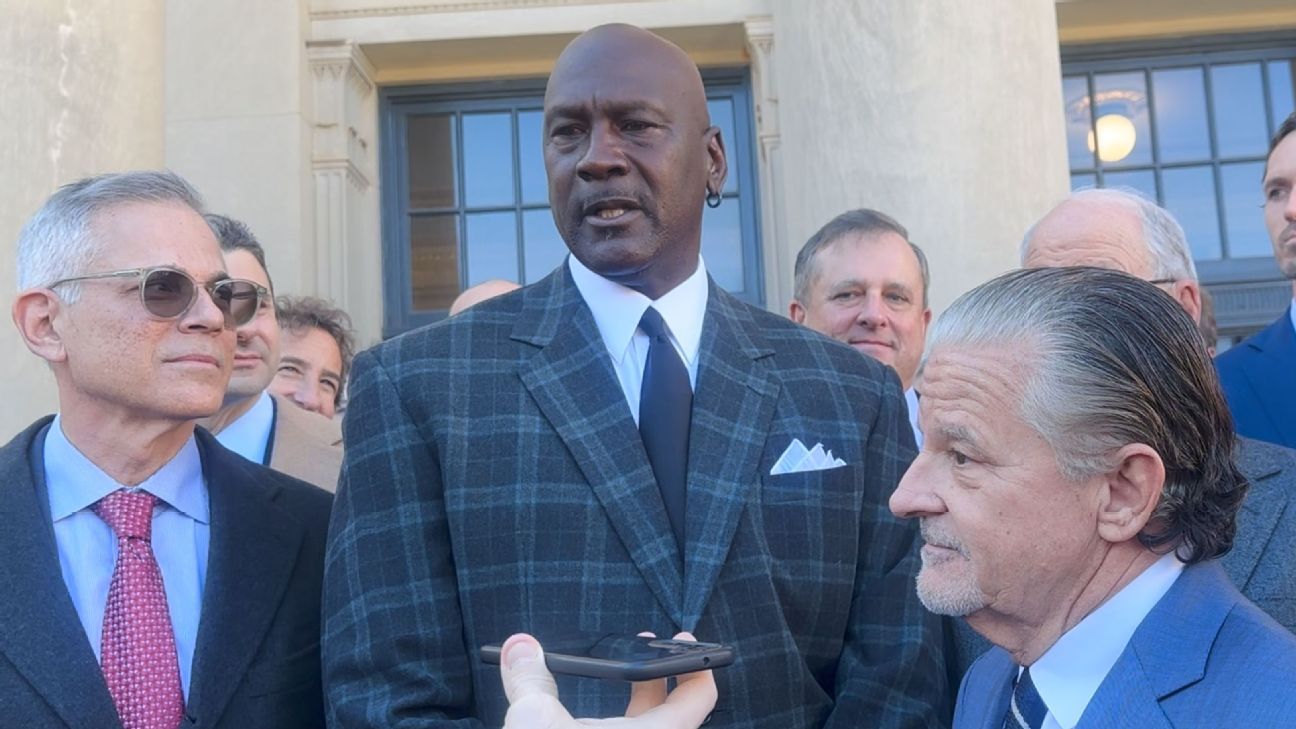
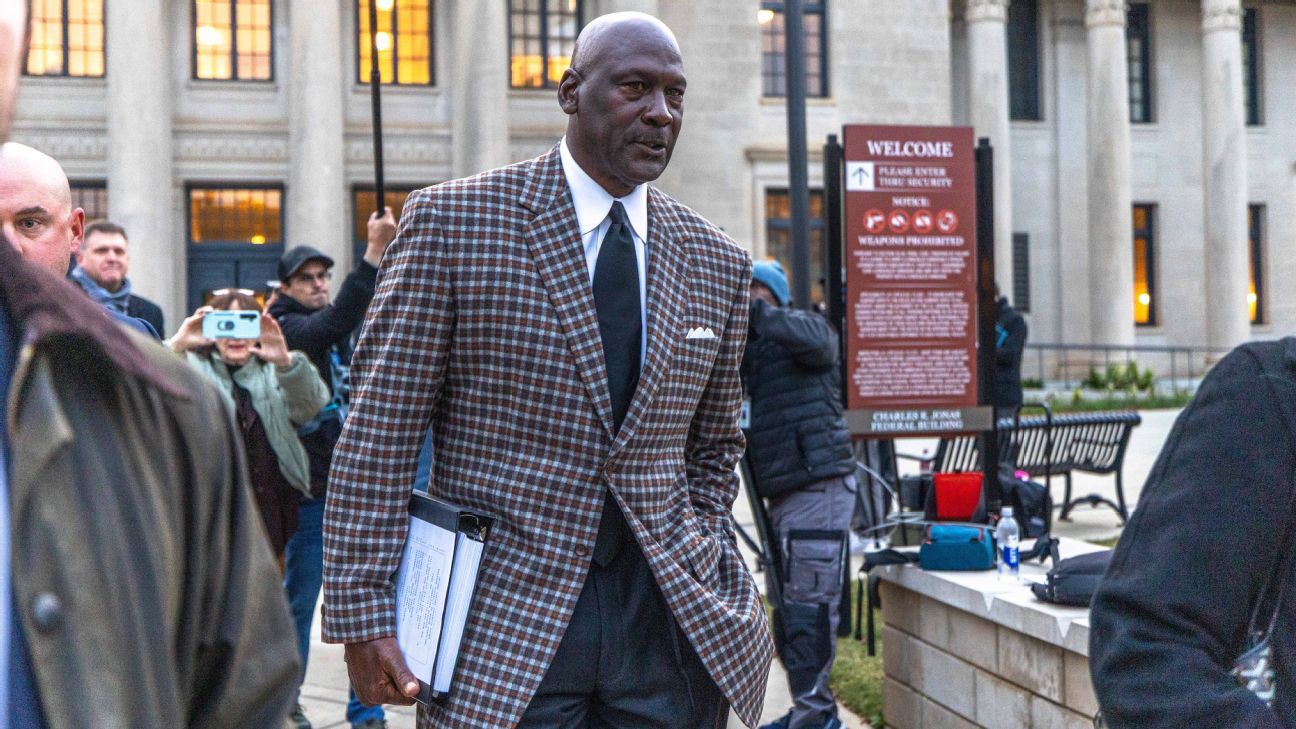
As an antitrust lawsuit against NASCAR, filed by 23XI Racing, co-owned by Michael Jordan and three-time Daytona 500 winner Denny Hamlin, and Front Row Motorsports (FRM), began to grind its way toward the end of its second week, the two sides announced that they had reached a settlement.
As the finer details of the agreement were still being revealed into late afternoon, there was no doubt that the victory belonged to the teams over the sanctioning body because we already knew that their ultimate goal had been achieved. In the end, this was about their fight for NASCAR to make team charters, as close as stock car racing gets to stick-and-ball franchises, permanent — or as their attorney Jeffrey Kessler described it, “evergreen” — as opposed to a contract-to-contract model, renewed in conjunction with NASCAR’s massive media rights deals.
It is very difficult to find someone in the Cup Series paddock who does not believe this is the right move. In fact, every team in the Cup Series garage once stood with 23XI and FRM, although they eventually relented and were willing to let those two teams carry ahead with the fight alone. They won that fight, and as a result, so did every NASCAR team owner who is fortunate enough to have one of those 40 charters. No one calls this franchising, but that’s essentially what it now is, in line with the business model of nearly every other big league sport, such as Jordan’s longtime home, the NBA.
NASCAR lost that fight. As the trial slogged on, a defeat began to feel inevitable, for the same reason that Jordan and his team believed that the latest charter agreement, the one they refused to sign in September 2024, was unsatisfactory. A reason that everyone in that garage, including NASCAR’s commissioner and president, had already talked about behind closed doors — and in emails and texts that were revealed in and around the trial — but no one spoke about publicly until the lawsuit forced them to.
The door to the future was being blocked by a dinosaur.
Jim France is a good man, a brilliant businessman and someone who loves auto racing on a level that few can understand. But he also never wanted the job he now holds as NASCAR’s CEO and chairman. His father, Bill France, originated the position after he oversaw NASCAR’s foundational meetings in 1948. His older brother, Bill France Jr., took over those duties from their father in the early 1970s and ruled the sport for three decades with a highly respected iron fist. His heir was his son Brian, whose tenure at the helm was tumultuous at best and ended prematurely in 2018.
Through it all, legendarily introverted Jim France was happy to remain in the background, racing sports cars and working in the racetrack ownership division while enjoying much sway in the NASCAR boardroom without any of the public spotlight that his father and brother both so loved and his nephew so loathed.
But when Brian France stepped down and NASCAR’s leadership flowchart was unexpectedly detoured, it ran directly over Jim France’s desk, whether he wanted it or not. “The Steves,” NASCAR commissioner Phelps and president O’Donnell, have been the faces of that leadership, a constant paddock presence as they meet with the media and their teams. But both have always been quick to politely remind that whatever decisions they made or moves they pondered, all went through the family first, being Jim, niece Lesa France Kennedy and her son Ben.
That was clear to everyone in the sport when it came to the introduction of charters in 2016, a concept created in conjunction with team owners to help meet their financial demands. It became even clearer that everything ran through France when the latest charter agreement tug-of-war took place over the two years leading into the current agreement.
As was revealed in court, NASCAR’s most powerful team owners pleaded with France personally to make their case for a more favorable charter agreement. When asked about those meetings this week, France testified that he considered them all great friends, but he was unmoved by their pleas.
As was also revealed in court, the people who worked for France were frustrated by their repeated attempts to get him to greenlight the compromises they had reached with those owners but were rebuffed by a man they were obviously referring to in text messages such as “1996 … dictatorship,” although they refused to identify that as France during their time on the stand.
At some point, during all of that, Jim France finally realized that, no, this isn’t 1996, when his brother had the sport picking up speed toward an unparalleled decade of growth. Nor is it 1966, when his father was building and collecting the portfolio of speedways that are still the backbone of NASCAR and the France family fortune. This isn’t even 2016, when charters were born.
Instead, we are staring into 2026. Today’s world is an open book. There are no secrets. No one knows that better than NASCAR and its race teams, having had 77 years of a closed-door/closed-ledger way of doing business laid bare during this trial. For the first time, we now know how much teams and their drivers make — and lose — and we know how much cash flows through the sanctioning body’s Daytona HQ and into the France family’s bank accounts.
And when it comes to collateral damage, race fans are rightfully incensed that the commissioner of NASCAR called Richard Childress, who teamed up with Dale Earnhardt to win six Cup titles, a “stupid redneck.” We now know that Joe Gibbs, a three-time Super Bowl-winning coach and five-time Cup Series champion owner, was moved to tears when he called Jim France to say “Don’t do this us!” and was told it was his fault in part because spending habits on his team were reckless. The France family now knows how displeased their lieutenants have been. Hell, I didn’t know that Hamlin believes that I’ve spent my entire career being scared of NASCAR people until he tweeted it on the eve of the trial.
Nothing says the holiday season like a vicious family fight. An airing out of long-simmering familial grievance that steps and then resteps over a line that had long been regarded as uncrossable. Your uncle finally spoke his mind about your mom’s drinking. Your sister finally got it off her chest that your spouse creeps her out. Your mother-in-law, caught up in the heat of the moment, called you a bad parent and then piled on by adding that you also never split the check at family dinners.
So, once that clash has ended and everyone is done calling out hard truths that everyone in the family already knew but no one dared say aloud, the only thing worse than the shouting is the awkward silence that follows.
Where do you go from there?
On Thursday morning, Jim France stood with Michael Jordan, surrounded by NASCAR executives, members of the France family, Hamlin, and an endless sea of lawyers. As the dinosaur and the GOAT were shoulder-to-shoulder on the steps of the very courthouse where they had just held a very public family fight, that’s the question that hovered over the scene like a storm cloud over the Daytona 500.
Some will say, as Jordan did after the settlement, that it was never personal, but strictly business. The business model of stock car racing is moving forward, and everyone seems to agree that’s the right plan of action. But hurt feelings never heal that quickly, do they?
Few communities in sports are like NASCAR. A relatively small group of people who travel together every weekend nearly year-round. It is genuinely like a family.
It’s never easy for any family to tell the patriarch he needs to hand over his car keys. You always hope he’ll realize he needs to do it first. On Thursday, Jim France did just that. Not every key on the chain, but certainly more than he, his father or his brother had ever given up before.
Hopefully, it wasn’t too late.


-
Andrea Adelson
THE JOKES ARE easy enough to make between “old man” Haynes King and his position coach, the oldest man to ever win the Heisman Trophy.
Twenty-five years ago, when Chris Weinke took home the award as a 28-year-old senior, his age became a nonstop topic of conversation. Today, older quarterbacks dot the college football landscape, their advanced ages met with a collective shrug.
“Sometimes I try and mess with him and say, ‘I couldn’t quite catch you on the age, but I tried. I gave it my all,” the 24-year-old King said of Weinke, his quarterbacks coach at Georgia Tech.
Older players have been normalized, thanks to the transfer portal and the pandemic, which granted freshmen an extra year of eligibility if they wanted it. Nearly 40 quarterbacks from the 2020 class came back this year for one more season at the FBS level. Plus, with NIL and revenue sharing, some quarterbacks are opting to stay in college as opposed to leaving school for the NFL draft. And sixth-year quarterbacks like King and Vanderbilt’s Diego Pavia entered the Heisman conversation this year. (Pavia was named a finalist.) Still, if more quarterbacks are 24 years old these days, nobody is quite as aged as Weinke was when he played.
“The landscape of college football has obviously changed,” Weinke says. “But that was a point of contention when I won it. When I walked into the room that evening when they were making the Heisman announcement, I didn’t think I was going to win it, because there was so much chatter that I didn’t deserve to win it because I was older.
“But I’ve got it now, and they can’t take it away.”
Perhaps the conversation around what Weinke did in 2000 at Florida State should be reframed. What made that season so remarkable had nothing to do with age, and everything to do with how he turned himself into a star after his college football career nearly ended. Twice.
FLORIDA STATE OFFENSIVE coordinator Mark Richt was sitting in his office in 1996, when then-coach Bobby Bowden came in with some news. At the time, Richt was closing in on getting a commitment from the top quarterback prospect in the country, Drew Henson. That is, until Bowden told him about a promise he had made to Weinke six years earlier.
Weinke had initially signed with the Seminoles in 1990, joining a quarterback room that included Brad Johnson, Casey Weldon and fellow freshman Charlie Ward. But he also had a lucrative offer to play baseball with the Toronto Blue Jays organization, after being selected in the second round of the MLB draft. Weinke had until classes started in late August to decide which sport he was going to play, so he opted to begin fall practice with Florida State while weighing his options.
He went through fall two-a-days, and with decision day closing in, Richt remembers one quarterback meeting in particular. To make sure his quarterbacks understood what he was teaching them, he would ask them questions.
Richt turned to Weinke as they watched tape and asked, “What coverage is this on this play?”
“Cover 3?” Weinke guessed.
“No.”
“Cover 1?
“No. It’s quarters coverage,” Richt said.
Weinke responded: “Whatever.”
“That was the day before school started,” Richt said. “I said, ‘I got a feeling this kid is going to leave and play pro baseball.'”
Sure enough, Weinke left. But Bowden told him if he ever decided to return to football, he would have a spot waiting for him at Florida State.
After six years of bouncing around the minor leagues and getting as high as Triple-A, Weinke decided to give up on baseball, but not playing sports entirely. He wanted to go back to football. Richt reminded Bowden that if they took Weinke, they would lose Henson.
“Well, I promised him if ever wanted to play football again, I’d let him come back,” Bowden told Richt.
Richt asked to speak with Weinke first.
“I was telling him all the rules and regs, I was telling him about [quarterback] Dan Kendra already on campus and when I’m done giving him my spiel to try to get him not to come, he says, ‘Hey coach, let me ask you one question. If I’m the best guy, will I play?’ I said, ‘Of course.’ He goes, ‘I’m coming.’ We lost the other quarterback to Michigan. I guess we came out OK with Weinke.”
Nobody quite knew what to expect when he arrived on campus as a 25-year-old freshman in 1997, but he quickly became one of the guys, in part because he had a large house off campus and threw his fair share of parties where all were invited.
The larger issue was that he arrived as a baseball player. Weinke had not picked up a football in six years.
Getting his form back would take time and reps. Lots and lots of reps. Former teammates and coaches described Weinke’s competitiveness, work ethic and relentless demeanor as driving forces. He would never settle for anything less than his best effort; and he expected the same from his teammates.
That is why he woke up before class started and went to watch tape with Richt. Why he organized every voluntary 7-on-7 workout and essentially made them mandatory. Because if someone failed to show up, he would go and find them and bring them out to the practice field. He developed such a great rapport with his receivers that he would be able to anticipate where they would be at any given time on the field.
“Our chemistry was like none other,” said Marvin “Snoop” Minnis, his leading receiver in 2000. “He knew what I was going to do before I did. He would have the ball to me before I even got out of my break, and as a receiver, you love that so you can react and make the move you need to make on the defender.”
Weinke played sparingly in 1997 but won the starting job in 1998. Things started well enough in the opener. Then in his second career start, at NC State, Weinke threw a school-record six interceptions, and the criticism began.
“I remember getting back to the house, we had an answering machine back then. The most brutal messages you could imagine, cursing and threats, and ‘You don’t need to play quarterback,'” said Jeff Purinton, who was working in the Florida State media relations department at the time and was one of Weinke’s roommates. “Even going to the store, people would talk trash. Chris just weathered it and used that as an opportunity to learn.”
Weinke rebounded from there, helping Florida State reel off eight straight wins. That last win, against Virginia, was nearly the last time he saw the field.
TOWARD THE END of the first half, Weinke got sacked and felt pain in his right arm. He initially thought he had a shoulder injury. Weinke went into the locker room at halftime, and as trainers began to lift off his shoulder pads, he had a sharp pain in his neck. He was fitted with a brace and underwent further testing.
When the doctor walked in to deliver the results, Weinke remembers asking, “Before you share any news, I just want to know one thing. Am I ever going to play college football again?”
“Well,” the doctor said. “Do you want the good news or the bad news?”
The doctor said Weinke needed surgery to insert a titanium plate into his neck after X-rays showed a chipped bone lodged against a nerve in a vertebra, ligament damage and a ruptured disc.
“Maybe the better news,” the doctor said. “You were a centimeter away from being paralyzed from the neck down.”
“Mom hears that, and dad hears that. They’re not real excited about me getting back out on the field,” Weinke says. “But they knew that burning desire inside of me that wanted to get back out there and be a part of the team. The doctors told me that I’d be stronger with a titanium plate in my neck, so I was going to do whatever it took. But those were probably the hardest seven months of my life.”
Weinke initially had complications post-surgery and had to be in bed for five weeks. He lost 30 pounds, and his throwing arm atrophied so severely that it became impossible for him to even lift a football. He had to teach himself again how to throw, starting first with a tennis ball. Throwing it 5 yards was a huge accomplishment. Seven hours a day, day after day, he rehabbed, steadily progressing, all the while unsure whether he would make it all the way back.
Then, there he was in the season opener against Louisiana Tech, completing 63% of his passes, throwing for 242 yards and two touchdowns. That was the start of an undefeated national championship-winning season in 1999, as Florida State went wire to wire as the No. 1 team in the nation.
Weinke opted to return for one more season, because he wanted to get Bowden another national championship. After throwing for 3,432 yards, 29 touchdowns and 15 interceptions as a junior and winning the title, Weinke became one of the Heisman front-runners headed into 2000.
TWENTY-FIVE YEARS LATER, there is one play from that season that remains a part of Seminoles lore: Weinke to Minnis, 98 yards, in a 54-7 blowout win over Clemson in mid-November.
On the second series of the game, backed up near the goal line, Florida State ran what Bowden referred to as a “gym play” — one that was never practiced on the field, but rather behind closed doors inside the gym away from prying eyes. “Or spies,” Richt said.
Weinke dropped back deep into the end zone and faked a handoff to Jeff Chaney, turning his back to the defense and tucking the ball as if he no longer had it. Minnis had gone in motion and made the safety think he was blocking for a handoff, then took off down the middle. By the time Weinke delivered the ball, Minnis was wide open. Easy touchdown. Easy 54-7 win.
“He was so ice cold in that moment,” Minnis said. “The confidence that he had in the O-line to just stand there, then turn around and hit me for the touchdown. For him to make that fake as beautiful as he did and then put that ball on a dime just tells you how great Chris Weinke was and how deserving he was of that Heisman Trophy.”
There was another game that added to his legend: The regular-season final against the rival Gators. Weinke had missed the 1998 game in Gainesville because of his neck injury. Nothing would keep him from playing them in The Swamp in 2000. Not even the flu.
Weinke was so sick the night before the game, he stayed at the home of team doctor Kris Stowers so he would not be around the rest of the team in the team hotel. He rode with Stowers to the game on Saturday, and walked through all the tailgate lots on the way to the locker room. Trainers gave him an IV before the game started, and Weinke proceeded to throw for 353 yards and three touchdowns in the 30-7 win.
Florida State was well positioned to make it back to the national title game, and Weinke was also well positioned in the Heisman Trophy race. But as the weeks drew closer to the announcement of the Heisman finalists, critics waged a campaign against Weinke — saying his age should disqualify him from consideration. That angered his teammates.
“He dominated that year, and it had nothing to do with age,” Minnis said. Added running back Travis Minor: “When he got there, he wasn’t looking like a Heisman Trophy candidate or winner. He really put the work in. You saw the difference from when he first got there to when he had that Heisman Trophy season. He earned everything that he won.”
Florida State knew it had to start working on messaging with Heisman voters as the debate over his age raged on. Ultimately, school officials came back to one main point: It was hard to argue with the stats. Weinke had led the nation with 4,167 yards passing and 33 touchdowns and had the Seminoles playing in a third straight national championship game.
“He was playing baseball for six years. It wasn’t like he was throwing the football every day and training to be a starting college quarterback,” Purinton said. “The other part is he could have died when he broke his neck. There were two points in time where he had to go back and start football over again.”
Weinke said the narrative taking shape around his age “pissed me off.”
“I was playing college football, so if I’m playing college football, then I should be eligible to win any award that they’re giving out in college football,” Weinke said. “That was just a little motivating factor for me.”
Weinke ultimately made it to New York with fellow finalists Josh Heupel, LaDainian Tomlinson and Drew Brees. His teammates watched on television screens from the team banquet Florida State had scheduled for that night.
“Sitting in the Downtown Athletic Club coming out of a commercial break and them announcing your name will ring in my head till the day I die,” Weinke said.
Weinke beat out Heupel in one of the closest votes in Heisman history, taking a 76-point margin of victory. His teammates whooped and hollered for him back home. Weinke took the stage and said, “With apologies to Lou Gehrig, I feel like I’m the luckiest man in the world.”
WEINKE BEGAN COACHING 10 years after he won the Heisman. He first came to know King while working as an assistant at Tennessee in 2020. When King hit the portal in 2022, Weinke had moved on to Georgia Tech. His first call was to King.
“Playing quarterback is kind of tricky,” King says. “The stars have to align, whether it’s people around you and or how you’re playing. Even in my class, there were guys like Bryce Young and Anthony Richardson and C.J. Stroud, already in the league, and I’m still in college like Chandler Morris, Diego Pavia, Carson Beck. Everybody’s timeline is different.”
While the debate over his age has been left to the dustbin of history, what Weinke did that year may never be replicated. In an era of sport and position specialization, quarterbacks rarely play multiple sports at elite levels — let alone leave football behind for six years before coming back to it. In the 25 years since Weinke won the Heisman, Brandon Weeden at Oklahoma State is perhaps the only notable quarterback to play baseball and then stick around in college football into his late 20s.
“To go through the things that I went through was clearly the road less traveled,” Weinke said. “Being an older guy and not playing football for seven years, then fulfilling a dream of playing for Coach Bowden, then breaking my neck, and coming back and giving Coach Bowden his first undefeated season, and ultimately having my name called for the Heisman Trophy, I just felt blessed.”
-
 Sports2 years ago
Story injured on diving stop, exits Red Sox game
-
 Sports3 years ago
‘Storybook stuff’: Inside the night Bryce Harper sent the Phillies to the World Series
-
 Sports2 years ago
Game 1 of WS least-watched in recorded history
-
 Sports3 years ago
Button battles heat exhaustion in NASCAR debut
-
 Sports3 years ago
MLB Rank 2023: Ranking baseball’s top 100 players
-
Sports4 years ago
Team Europe easily wins 4th straight Laver Cup
-
 Environment3 years ago
Japan and South Korea have a lot at stake in a free and open South China Sea
-
 Environment1 year ago
Here are the best electric bikes you can buy at every price level in October 2024