

Conservative Party pledges £1.6bn ICE-style ‘removals force’ to deport 150,000 illegal migrants a year


The Conservatives are pledging to create a new “removals force” to detain and remove 150,000 a year as part of a broad plan to tackle illegal immigration to the UK.
Modelled on the “successful approach” of the US Immigration and Customs Enforcement (ICE) agency, this new force would be given “sweeping new powers”, and over £1bn in funding.
The pledge is part of the Conservative Party’s broad new plans to stop illegal migration to the UK, set to be unveiled by Kemi Badenoch on the first day of their annual conference on Sunday, where reducing immigration and creating “Strong Borders” will be one of the key themes.
Tap here to follow the latest from Tory conference in Manchester
Speaking to Sky News’ Sunday Morning with Trevor Phillips ahead of her speech, shadow home secretary Chris Philp insisted this is a “detailed and comprehensive plan to get control of this country’s borders”.
However, Ms Badenoch did not provide specifics when asked on the BBC’s Sunday with Laura Kuenssberg where migrants being removed would go, claiming that question was “irrelevant”.
She said: “I’m tired of all of these irrelevant questions about where should they go. They will go back to where they should do or another country, but they should not be here.”
Pressed again, she added: “They will go back to where they came from.”
The new “removals force” that she will unveil later will replace the existing Home Office Immigration Enforcement (IE) and will be given broad new powers, including being able to use facial recognition without warning in order to spot illegal immigrants.
Sam and Anne discuss how comments made by their leader will be received by Conservatives ahead of their conference
👉Listen to Politics at Sam and Anne’s on your podcast app👈
It will be given funding of £1.6bn a year, up from the existing £820m a year, to increase the number of removals annually from 34,000 to 150,000 – which would represent “at least 750,000 removals” across a five-year parliament.
The Tories say this increase in funding would come from the closure of asylum hotels and “tackling the wider costs of our out-of-control asylum system”.
Expanding the use of live facial recognition technology is likely to attract criticism from within the Tory Party itself, on the grounds of it being a threat to individual freedom and privacy.
And ICE in the US has been heavily criticised by politicians and the public in recent months, with the agency accused of arresting both legal migrants and US citizens and targeting people based on their race.
The Trump administration has faced heavy criticism and lawsuits for deporting illegal migrants and foreign offenders to El Salvador’s notorious mega-prison, the Terrorism Confinement Center (CECOT), including a man who was wrongly sent there, having been granted permission to remain in the US.
Nigel Farage has said violent UK offenders could be jailed overseas under his plans to cut crime by half. The Reform UK leader named El Salvador as a likely destination, though he said he has not held conversations with officials there and “multiple” partners would be considered.

Sky’s Mark Stone speaks to an undocumented migrant living in fear of detention and deportation in the US
Tories to withdraw from multiple conventions
In addition to confirming plans to leave the European Convention on Human Rights (ECHR), announced on Saturday, Ms Badenoch will also vow to fully repeal the Human Rights Act, and leave the Council of Europe Convention on Action Against Trafficking in Human Beings.
This, the Tories say, would “end the legal blocks that allow illegal immigrants, and in some cases foreign criminals, to stay in the UK based on flimsy claims”.

The clamour from the right for the UK to withdraw from the European Convention on Human Rights has been growing – would it make a difference?
A radical overhaul of the asylum system would see refugee status granted only to those threatened by a foreign government, and those fleeing conflict or “less tolerant” laws on religion or sexuality would not be eligible, with the party saying “few people will qualify”.
Read more:
Tory conference – a chance for Badenoch to turn her fortunes around?
Leaked data shows Tory conference might have smaller crowd this year
Badenoch says Tories will quit ECHR if they win next election
The plan will also see the immigration tribunal abolished, with all decisions on migration taken by the Home Office with only limited rights of appeal in cases where officials have acted without statutory authority.
Immigration cases will be denied legal aid, with the Tories accusing solicitors of having “defrauded” the UK by “coaching” applicants and arguing there is “no need for lawyers” as people “should simply tell the truth about their circumstances”.

Prime minister rules out leaving ECHR
‘Labour is fixing the Tories’ mess’
The plans come as Ms Badenoch faces continued pressure on her right flank from Reform UK, which has already pledged to leave the ECHR and deport up to 600,000 people over five years if it comes to power.
But the party leader said the plans put forward by Nigel Farage’s party are “nothing but announcements that fall apart on arrivals”.
She also said the Labour government offers “failed gimmicks”, adding: “Our Stronger Borders plan is serious and credible and backed by a comprehensive legal analysis. That is the difference the next Conservative government will deliver.”

Kemi Badenoch wants to create a ‘Removals Force’ modelled on the US Immigration and Customs Enforcement (ICE) agency. Pic: Reuters
A Labour Party spokesperson said: “The Conservatives’ message on immigration is: we got everything wrong, we won’t apologise, now trust us.
“It won’t wash – Kemi Badenoch’s party enabled record high net migration as removals plummeted, opened over 400 asylum hotels and wasted £700 million of taxpayers’ money to send just four volunteers to Rwanda.
“This Labour government is fixing the Tories’ mess by smashing the people-smuggling gangs running the vile small boats trade, closing asylum hotels, deporting foreign criminals and signing international returns deals to bring order to Britain’s borders.”
Hear more about the plans from shadow home secretary Chris Philp, live at the Conservative Party Conference in Manchester on Sunday Morning With Trevor Phillips from 8.30am.


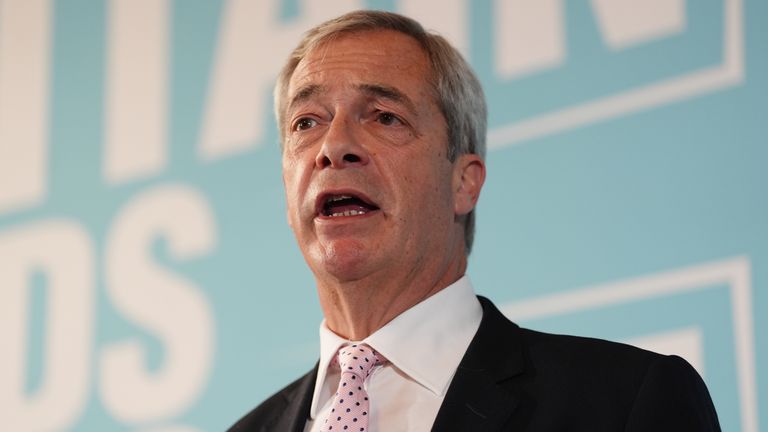
Millionaire Tory donor Malcolm Offord has defected to Reform UK, saying he would be campaigning “tirelessly” to “remove this rotten SNP government”.
Nigel Farage announced the former Conservative life peer’s defection during a rally in the Scottish town of Falkirk, where regular anti-immigration protests have taken place outside the Cladhan Hotel – which is being used to house asylum seekers.
Mr Farage, Reform UK’s leader, said he was “delighted” to welcome Greenock-born Lord Offord to Reform, describing his defection as “a brave and historic act”.
He added: “He will take Reform UK Scotland to a new level.”
During a speech, Lord Offord, who previously donated nearly £150,000 to the Tories, said he would be quitting the Conservative Party and giving up his place in the House of Lords as he prepares to campaign for a seat in Holyrood in May.
The 61-year-old said he wanted to restore Scotland to a “prosperous, happy, healthy country”.
“Scotland needs Reform and Reform is coming to Scotland,” he told the rally.
Read more:
Nigel Farage dismisses school racism claims as ‘banter in a playground’
Farage allegations are deeply shocking – but will they deter voters?
“Today I can announce that I am resigning from the Conservative Party. Today I am joining Reform UK and today I announce my intention to stand for Reform in the Holyrood election in May next year.
“And that means that from today, for the next five months, day and night, I shall be campaigning with all of you tirelessly for two objectives.
“The first objective is to remove this rotten SNP government after 18 years, and the second is to present a positive vision for Scotland inside the UK, to restore Scotland to being a prosperous, proud, healthy and happy country.”
The latest defection comes as Mr Farage finds himself at the centre of allegations of racism dating back to his time in school.
Claims made against Nigel Farage
Sky News reported on Saturday that a former schoolfriend of Mr Farage claimed he sang antisemitic songs to Jewish schoolmates – and had a “big issue with anyone called Patel”.
Jean-Pierre Lihou, 61, was initially friends with the Reform UK leader when he arrived at Dulwich College in the 1970s, at the time when Mr Farage is accused of saying antisemitic and other racist remarks by more than a dozen pupils.
Mr Farage has said he “never directly racially abused anybody” at Dulwich and said there is a “strong political element” to the allegations coming out 49 years later.
Reform’s deputy leader Richard Tice has called the ex-classmates “liars”.
A Reform UK spokesman accused Sky News of “scraping the barrel” and being “desperate to stop us winning the next election”.

The European Commission’s proposal to expand the powers of the European Securities and Markets Authority (ESMA) is raising concerns about the centralization of the bloc’s licensing regime, despite signaling deeper institutional ambitions for its capital markets structure.
On Thursday, the Commission published a package proposing to “direct supervisory competences” for key pieces of market infrastructure, including crypto-asset service providers (CASPs), trading venues and central counterparties to ESMA, Cointelegraph reported.
Concerningly, the ESMA’s jurisdiction would extend to both the supervision and licensing of all European crypto and financial technology (fintech) firms, potentially leading to slower licensing regimes and hindering startup development, according to Faustine Fleuret, head of public affairs at decentralized lending protocol Morpho.
“I am even more concerned that the proposal makes ESMA responsible for both the authorisation and the supervision of CASPs, not only the supervision,” she told Cointelegraph.
The proposal still requires approval from the European Parliament and the Council, which are currently under negotiation.
If adopted, ESMA’s role in overseeing EU capital markets would more closely resemble the centralized framework of the US Securities and Exchange Commission, a concept first proposed by European Central Bank (ECB) President Christine Lagarde in 2023.
Related: Bank of America backs 1%–4% crypto allocation, opens door to Bitcoin ETFs
EU plan to centralize licensing under ESMA creates crypto and fintech slowdown concerns
The proposal to “centralize” this oversight under a single regulatory body seeks to address the differences in national supervisory practices and uneven licensing regimes, but risks slowing down overall crypto industry development, Elisenda Fabrega, general counsel at Brickken asset tokenization platform, told Cointelegraph.
“Without adequate resources, this mandate may become unmanageable, leading to delays or overly cautious assessments that could disproportionately affect smaller or innovative firms.”
“Ultimately, the effectiveness of this reform will depend less on its legal form and more on its institutional execution,” including ESMA’s operational capacity, independence and cooperation “channels” with member states, she said.
Related: Grayscale Chainlink ETF draws $41M on debut, but not ‘blockbuster’

The broader package aims to boost wealth creation for EU citizens by making the bloc’s capital markets more competitive with those of the US.
The US stock market is worth approximately $62 trillion, or 48% of the global equity market, while the EU stock market’s cumulative value sits around $11 trillion, representing 9% of the global share, according to data from Visual Capitalist.
Magazine: EU’s privacy-killing Chat Control bill delayed — but fight isn’t over
-
 Sports2 years ago
Story injured on diving stop, exits Red Sox game
-
 Sports3 years ago
‘Storybook stuff’: Inside the night Bryce Harper sent the Phillies to the World Series
-
 Sports2 years ago
Game 1 of WS least-watched in recorded history
-
 Sports3 years ago
Button battles heat exhaustion in NASCAR debut
-
 Sports3 years ago
MLB Rank 2023: Ranking baseball’s top 100 players
-
Sports4 years ago
Team Europe easily wins 4th straight Laver Cup
-
 Environment3 years ago
Japan and South Korea have a lot at stake in a free and open South China Sea
-
 Environment1 year ago
Here are the best electric bikes you can buy at every price level in October 2024