
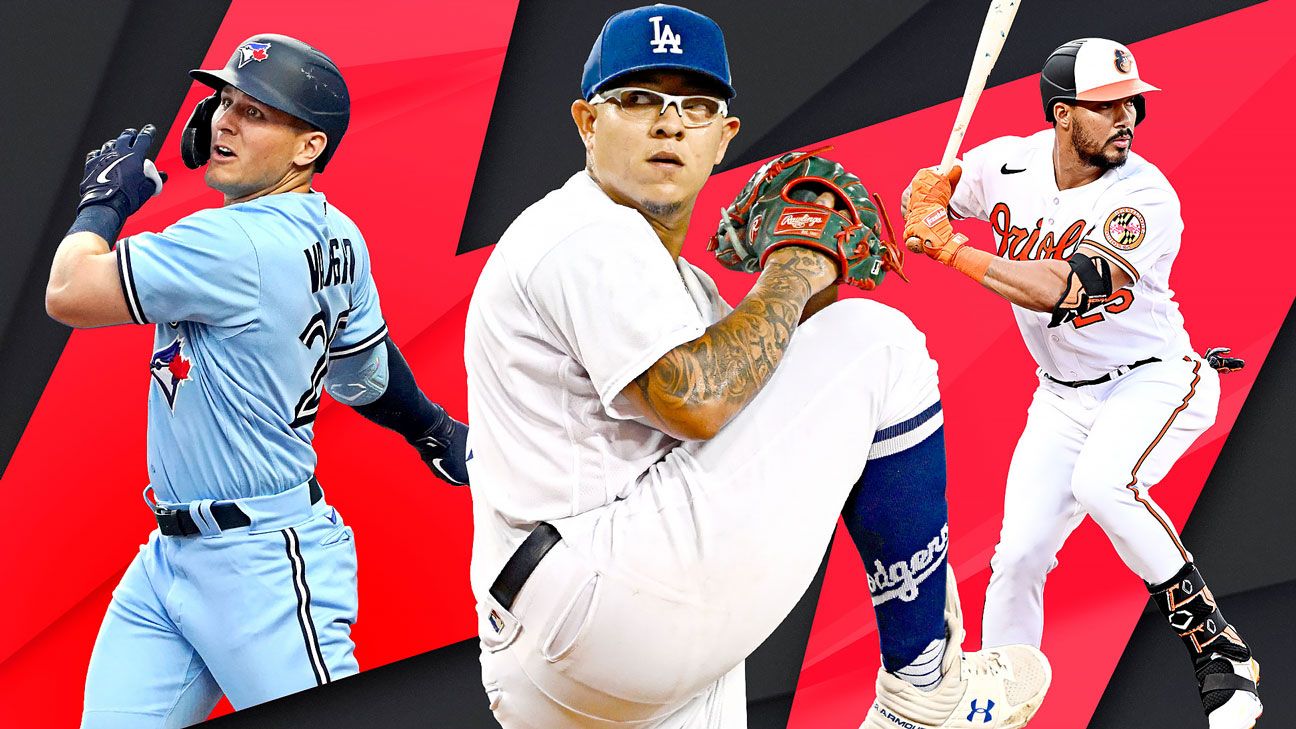
MLB Power Rankings: Which red-hot division dominates the top 10?


After playing a larger variety of teams in the first six weeks of the season thanks to the new schedule, the American League East has cemented itself as the most competitive division in baseball — and in our MLB Power Rankings.
All five clubs reside in the top 10, with the two most historically dominant AL East teams — the Yankees and Red Sox — bringing up the rear for the group. But it raises the question: Is this level of success sustainable?
Our expert panel has combined to rank every team in baseball based on a combination of what we’ve seen so far and what we already knew going into the 162-game marathon that is a full baseball season. We also asked ESPN MLB experts David Schoenfield, Bradford Doolittle, Jesse Rogers, Alden Gonzalez and Joon Lee to weigh in with an observation for all 30 teams.
Record: 29-9
Previous ranking: 1
The Rays keep rolling, going 9-4 since the team encountered a hiccup against the Astros, getting shut out in back-to-back games. Wander Franco continues to lead the offense, collecting 10 hits in 29 at-bats over the past week, including two homers. Franco could find himself in the MVP conversation if he continues this type of production, leading all position players with 2.5 Baseball-Reference WAR (bWAR). — Lee

Record: 25-12
Previous ranking: 2
Max Fried‘s forearm strain will require him to be shut down until he’s healed, which could be up to two months, but the Braves appear hopeful they caught the injury before something more severe develops. (A forearm strain is often a precursor to Tommy John surgery, which Fried had as a minor leaguer in 2014.) In more positive news, Sean Murphy and Ronald Acuna Jr. continue to rake and ranked first and fourth among position players in FanGraphs WAR (fWAR) through Tuesday. Murphy had a six-RBI game against the Mets on May 1, four RBIs against the Orioles on May 5 and four more against the Red Sox on Tuesday, pushing him into the National League lead with 32. He’d get my vote right now as NL MVP over Acuna. — Schoenfield

Record: 23-15
Previous ranking: 3
The Dodgers possess the depth to sustain most setbacks. But with Walker Buehler spending most — if not all — of the 2023 season recovering from Tommy John surgery, they needed one of their dynamic young starting pitchers to step up behind the established duo of Julio Urias and Clayton Kershaw. Enter Dustin May. Seven starts in, May boasts a 2.68 ERA and a 0.94 WHIP. His strikeout rate is only 18.4%, even though he consistently throws in the upper 90s, and his groundball rate is below average despite the presence of a devastating sinker. His exit data, meanwhile, is around league average. So how, exactly, is he doing this? Some of it might have been luck thus far, but May undoubtedly has the stuff to produce at this level moving forward. — Gonzalez

Record: 21-16
Previous ranking: 5
Toronto received a reminder of how deep the American League East is when it was swept by the Red Sox in a four-game series at Fenway Park, though the Jays rebounded by sweeping the Pirates. One major encouraging sign for this team: Outfielder Daulton Varsho had four multihit games during the past week, helping raise his average more than 40 points after a slow start to the season. Additionally, righty Chris Bassitt had his strongest start of the season, going seven innings and allowing no runs on four hits while striking out five and walking four against Pittsburgh. — Lee

Record: 22-14
Previous ranking: 8
It’s a different hero every week for the still-in-first place Rangers. This time it’s outfielder Leody Taveras, who delivered in a big way over a seven-day span ending Tuesday — going 11-for-23 (.478) during that time frame while getting on base well over 50% of the time. It’s been a different story for the Rangers on the mound, as closer Andrew Heaney gave up nine runs in 11⅓ innings over two starts. He’s been wildly unpredictable in his first year with the Rangers, giving up at least two earned runs in five of his seven starts for a 5.25 ERA on the season. Without Jacob deGrom, Texas will need more from its pitching staff. — Rogers

Record: 19-18
Previous ranking: 4
The Astros received some rough injury news last week when Luis Garcia was removed eight pitches into a start against the Giants because of what was later diagnosed as a torn ulnar collateral ligament (UCL). Garcia is now headed for Tommy John surgery and is done for the season. The Astros’ rotation was already without Jose Urquidy (shoulder) and Lance McCullers Jr. (elbow). So, the vaunted depth of the Astros’ pitching is very much being put to the test. J.P. France and Brandon Bielak both got starts over the past week. — Doolittle

Record: 24-13
Previous ranking: 9
The Orioles dropped two of three to the Braves but rebounded by grabbing a series win over the red-hot Rays. Outfielder Anthony Santander had a strong week, collecting 12 hits and hitting three home runs in 29 at-bats. While Baltimore looks like an exciting young team off to a hot start, there are areas to improve upon, with the pitching staff in the middle of the pack for team ERA so far this season. Reliever Yennier Cano leads the team’s pitchers in bWAR, suggesting there’s room for improvement among the starting rotation. — Lee

Record: 19-18
Previous ranking: 10
Manager Bob Melvin made a relatively drastic change to his lineup on Tuesday, moving Jake Cronenworth up into the No. 2 hole and sliding three of his superstars back a spot. It led to one of their most complete offensive showings of the young season, particularly with regard to Manny Machado and Juan Soto, who combined to reach base seven times. The Padres’ offense has been surprisingly inconsistent thus far, beginning this week ranked 23rd in runs per game. At some point, one would think, it will all click. And perhaps Tuesday was the start of that. “It’s just putting it all together,” Machado said after Tuesday’s win over the Twins. “If we can do that, we’re going to be the best team in baseball.” — Gonzalez

Record: 21-17
Previous ranking: 12
The Yankees got some relief from the injury bug ravaging the team, as slugger Aaron Judge returned to the lineup Tuesday after dealing with a hip ailment. They will need the help, as New York ranks 19th in the league in fWAR while sitting 23rd in batting average. There seems to be more injury relief on the horizon, with Luis Severino starting a rehab assignment and third baseman Josh Donaldson increasing the intensity of his on-field work. In a potential setback, though, Carlos Rodon’s back injury was deemed “chronic” by doctors. — Lee

Record: 22-16
Previous ranking: 15
Following a four-game sweep of the division rival Blue Jays, Boston continued its hot streak with a series win against the Phillies on the road before splitting a two-game series with the Braves. Outfielder Masataka Yoshida took American League Player of the Week honors for May 1-7 after hitting .480 (12-for-25) with two doubles, two homers, eight RBIs, a walk, seven runs scored, an .800 slugging percentage and a .519 on-base percentage. Meanwhile, first baseman Triston Casas is showing some flashes at the plate, collecting five hits in 15 at-bats over the past week. — Lee

Record: 20-17
Previous ranking: 7
Milwaukee blew its chance to retake command of the division while the Pirates were playing the Rays and Jays in the East. Instead, the Brewers endured their own six-game losing skid, which included getting swept by the Rockies and barely escaping the Giants series with a win. Like for others in the division, regression has reared its head in Milwaukee — in this case, on offense. Playing at Coors Field did the Brewers no favors, as they scored just nine runs in the three games there. They woke up a bit in a 9-3 win over the Dodgers on Monday but followed that up with only a couple of runs scored in losses on Tuesday and Wednesday. If Christian Yelich could raise his OPS over .700, it would provide a big help. — Rogers

Record: 20-17
Previous ranking: 11
The Twins and, presumably, their fans were understandably thrilled when Carlos Correa‘s foray into free agency saw his flirtations with the Giants and Mets fall through, landing him back in the Twins Cities. The first few weeks of his return to Minnesota have been far from a fairy tale. Correa went 1-for-12 in a three-game series at Cleveland over the weekend, and then, in the first game of the Twins’ return to Target Field, he went 0-for-5, dropping his season average to as low as .185 on Tuesday.
Correa himself likes to point out that he’s a slow starter, though his career numbers suggest that it’s more true that he’s sometimes a slow starter. The underlying metrics aren’t alarming. Most of his ratios are around his career standards. He is going to the opposite field more and his average exit velocity is only about average, a tick down for him. As this is the first season of Correa’s new six-year contract, everyone will feel a lot better if his bat warms up with the weather. — Doolittle

Record: 18-19
Previous ranking: 6
The Mets are paying Justin Verlander, Max Scherzer, Kodai Senga, Carlos Carrasco and Jose Quintana a combined $128.6 million in 2023 — higher than the Opening Day payroll of 12 teams — but that group has started just 16 of the team’s first 37 games, including Verlander’s second start on Wednesday night.
Scherzer was scratched from his start on Tuesday because of neck spasms, and between that, his ejection and subsequent 10-game suspension for too much sticky substance and a short outing last time out, he has pitched just 22 innings in four starts (and has a 5.52 ERA). The fill-ins haven’t done well, either: David Peterson, Tylor Megill, Joey Lucchesi, Jose Butto and Denyi Reyes are a combined 5-9 with an ERA over 5.00. Most of that is on Peterson, who was solid in 2022 but is 1-5 with a 7.68 ERA. As a result: The Mets, once 14-7, are now under .500. — Schoenfield

Record: 20-17
Previous ranking: 17
Raise your hand if you had Geraldo Perdomo as the D-backs’ best hitter this season. Put it down — you’re lying. It’s still early, but Perdomo, Arizona’s 23-year-old shortstop, boasts a team-leading 1.033 OPS, with nearly as many walks (11) as strikeouts (15). Yes, the same Perdomo whose .262 slugging percentage in 2022 ranked dead last among those with at least 500 plate appearances. Perdomo’s slugging percentage is now up 311 points! He’s a solid defender at a premium position, but if he can continue to provide something close to this type of offensive production, the D-backs will be in business. — Gonzalez

Record: 20-18
Previous ranking: 18
Six weeks in and the Angels look … decent? They sport a winning record and a positive run differential. Shohei Ohtani and Mike Trout are playing up to their capabilities, Anthony Rendon is healthy — though he’s still waiting for his power to reemerge — and the back end of their bullpen seems to be rounding into shape. They do, however, have a catching problem. With Logan O’Hoppe sidelined by shoulder surgery, Max Stassi slow in his recovery from a hip injury and Chad Wallach recently suffering a concussion, the Angels were forced to call up a 28-year-old named Chris Okey, who had seven games of major league experience and was slugging .225 in the Pacific Coast League. If the Angels hope to contend, they’ll need to address their depth at this position at some point. — Gonzalez

Record: 18-19
Previous ranking: 20
Bryce Miller had a second straight strong start to begin his career, allowing one run and striking out 15 in 12 innings, and George Kirby just delivered one of his best starts as a pro with seven scoreless innings against the Rangers, but the Seattle offense continues to struggle. It’s time to admit the Mariners have a major strikeout problem from their best hitters. Through Tuesday, Teoscar Hernandez has 51 K’s and just five walks in 36 games. Julio Rodriguez has 45 K’s and 11 walks in 34 games. Eugenio Suarez has 45 K’s in 36 games. All are hitting under .230. Jarred Kelenic and Cal Raleigh are also averaging more than a strikeout per game. If those guys don’t improve, the Mariners will be stuck at .500 no matter how good the starting pitching. — Schoenfield

Record: 18-19
Previous ranking: 14
Philly lost six in a row to the Astros, Dodgers and Red Sox to fall back under .500. The Phillies are built around their stars and not all of them have been producing. Trea Turner has the feel of somebody perhaps feeling the pressure to live up to the big contract, with a higher strikeout rate and higher launch angle — the signs of somebody trying to hit home runs. A related concern, however: He ranked in the 57th percentile in chase rate in 2021, fell to the 22nd percentile in 2022 and is way down in the 10th percentile in 2023. He’s swinging at too many non-strikes. Kyle Schwarber, meanwhile, is hitting under .200 as he continues to morph into Adam Dunn — home runs and walks, but also a ton of whiffs and low batting averages. He had a 132 OPS+ last year, which is good; he’s below 100 this year, which isn’t good for a middle-of-the-order hitter. — Schoenfield

Record: 21-17
Previous ranking: 13
It’s been an ugly week for the Pirates, who somehow still find themselves in first place despite a seven-game losing streak that was followed by one win and then two more losses. At least they were able to cross Tampa Bay and Toronto off their schedule, because facing them was a miserable experience. The once-surprising Pirates staff compiled a 5.16 ERA from May 3 to May 9, third worst in the NL over that time span. Regression was predicted by many, and the Pirates lived up to it. Could a drop in the standings be next? Smart money says it’s coming. — Rogers

Record: 18-19
Previous ranking: 16
The Cubs are trying to thread the needle of a very winnable division while debuting players during the end of a mini retool. On Tuesday, the bottom three players in their lineup were two rookies playing in their first few days in the big leagues and another player making his season debut after being called up from Triple-A. So it’s not a surprise things have been a little up and down lately, especially on offense. Over the past 10 days, they’re averaging just over three runs per game, and calls for veteran Eric Hosmer to be designated for assignment are getting stronger. His WRC-plus is just 74. — Rogers

Record: 17-20
Previous ranking: 19
Run prevention is the foundation of these Guardians, but if Cleveland is going to successfully defend its AL Central title, it’ll have to hit at least a little. While that sounds like a low bar, the Guardians have not managed to clear it. The offense has been one of baseball’s worst over the season’s opening weeks, and the problem seems to be getting worse, not better. The Guardians’ 162-game runs scored pace was 810 as of April 9. Not bad. Last season, Cleveland scored 698 runs. That number has been going steadily down ever since. After dropping a 5-0 whitewash to the Tigers on Wednesday and slipping behind Detroit into third place in the AL Central, the Guardians are on pace to score 552 runs. That would be the fewest runs Cleveland has scored over a non-shortened season since 1971. — Doolittle

Record: 19-19
Previous ranking: 22
It continues to be a wild up-and-down ride for the Marlins, who are now 12-0 in one-run games and hovering around .500 despite getting outscored by 54 runs. Luis Arraez and Jorge Soler continue to carry the offense. Arraez had a nine-game stretch from April 30 through May 9 in which he hit .324 and got at least one hit in every game — but his average dropped from .438 to .408. Soler has been hot in May, including a two-homer, five-RBI game in Tuesday’s 6-2 win over Arizona. Sandy Alcantara continues to search for that Cy Young form. He scuffled against the Braves last Tuesday, throwing 103 pitches in just five innings, but rebounded with a strong outing of 8⅓ innings to beat the Cubs on Sunday. — Schoenfield

Record: 16-20
Previous ranking: 23
The Giants had a chance to win their third consecutive series to begin the month of May on Wednesday, but Sean Manaea was charged with eight runs (four earned) and couldn’t complete the third inning against the hapless Nationals. Manaea, signed to a two-year, $25 million contract over the offseason, has a 7.96 ERA with 16 walks through his first 26 innings as a member of the Giants. — Gonzalez

Record: 13-25
Previous ranking: 21
Could the ship be righting itself? The Cardinals produced their first (mini) winning streak of the year when they defeated the Tigers on Sunday then took a series against the Cubs this week. Of course, as all that was happening, they were creating more than just a mini controversy when they very publicly pulled Willson Contreras from his starting duties as catcher. He might return to the job soon but not before work is done to better the flow and communication between pitcher and catcher. There’s less time to think with a pitch timer, and the Cardinals aren’t maximizing all that they want to be. That improvement might come through pregame preparation. — Rogers

Record: 17-19
Previous ranking: 26
The Tigers’ push into second place in the division is one of the bigger surprises of the season (even if it is the AL Central), given where they projected to finish and because they seemed intent to justify those projections by starting the season 2-9. Still, the bigger picture remains the progress of their young players, and so far, that news has been encouraging. Spencer Torkelson is still trying to find his stride, but he has trimmed his strikeout rate and is hitting the ball hard more consistently. His numbers have been on the rise over the past week, with his OPS jumping more than 100 points during that span. Meanwhile, Riley Greene has been one of the team’s hottest hitters since late April. Since April 26, Greene has hit .327 with an .820 OPS. — Doolittle

Record: 15-21
Previous ranking: 24
If you can believe it, the Reds were the only NL Central team without a losing record over a 10-game span ending Tuesday. Going 5-5 probably never felt so good, but there are underlying pitching issues that need working out. Nick Lodolo has given up 50 hits in just 34⅓ innings to go along with a league-leading 10 home runs allowed. And Graham Ashcraft had a forgettable start against the White Sox over the weekend, giving up eight runs over 1⅔ innings. The result of all this was an MLB-worst 7.16 ERA for Cincinnati in its past five games (ending Tuesday). It’s a miracle the team actually went 5-5. — Rogers

Record: 13-25
Previous ranking: 25
While Andrew Vaughn‘s three-run winning homer did beat the mighty Rays on April 30, ending a 10-game skid and starting a three-game win streak, it did not seem to spark a prolonged streak of inspired play for the ChiSox. Instead, it has been win one, lose one over the past week. The news around the team has been in the same vein. In the “lose one” category, Eloy Jimenez landed on the IL after undergoing an appendectomy in Cincinnati. He’ll be out for a few weeks. But the “win one” items are pretty good: Liam Hendriks is back on the field and has been sharp during a rehab stint. And Yoan Moncada‘s ailing back improved enough for him to go on a rehab stint of his own, and his return to the majors looks imminent.
Perhaps the best news for a White Sox team that has possibly been baseball’s biggest disappointment is that it has been allowed to remain in the AL Central. Chicago never fell more than nine games back, and the win-one/lose one pattern was enough to cut 1½ games from that nadir. As bad as it has been, the White Sox still have plenty to play for. — Doolittle

Record: 16-22
Previous ranking: 28
The Rockies are playing better of late, winning seven of nine games to begin May. So, we’ll do our best to make this week’s section a positive one and point you in the direction of Kris Bryant, who played in only about a quarter of the team’s games in 2022, his first year of a massive contract. Bryant’s 2023 is off to a much better start, with a .301/.380/.451 slash line through his first 35 games. Still: He is one of only two regulars, along with Elias Diaz, with an adjusted OPS significantly above league average. — Gonzalez

Record: 16-21
Previous ranking: 27
MacKenzie Gore is 3-2 with a 3.65 ERA and showing improvement across the board, especially in the effectiveness of his curveball and slider. Last year, batters hit .250 with a 32% swing-and-miss rate against the curveball; this year, .154 with a 42% whiff rate. Batters hit .286 against the slider last season compared to .227 this season. The four-seamer hasn’t been as effective, although Gore continues to throw it 60% of the time — the fourth-highest four-seam percentage among starting pitchers. Of note as well: He hasn’t faced any of the bottom 10 offenses in his seven starts. — Schoenfield

Record: 11-27
Previous ranking: 29
The Royals have to be pleased with the progress of first baseman Vinnie Pasquantino, who has validated a solid debut season in 2022 with across-the-board improvements that have made him a complete package as a hitter. Certainly he has the slash stats covered, with a career batting line of .296/.383/.481. A left masher, Pasquantino has hit .330 against southpaws so far in his career. The one thing remaining is for Pasquantino to hit for power more consistently, as his sub-.500 slugging is a little light for someone with his bat-on-ball skills, advanced approach and 6-4, 245-pound build. He looks like the real deal. — Doolittle

Record: 8-30
Previous ranking: 30
The Athletics appear to be another step closer to leaving Oakland after the team reportedly reached an agreement with Bally’s Corporation to build a $1.5 billion stadium on the Tropicana Hotel site that resides on the southern end of the Las Vegas Strip, lowering the request for taxpayer funding for the project to $395 million. As for the Athletics, the team is currently on pace for around 45 victories, which would be the third-worst winning percentage in MLB history. — Lee
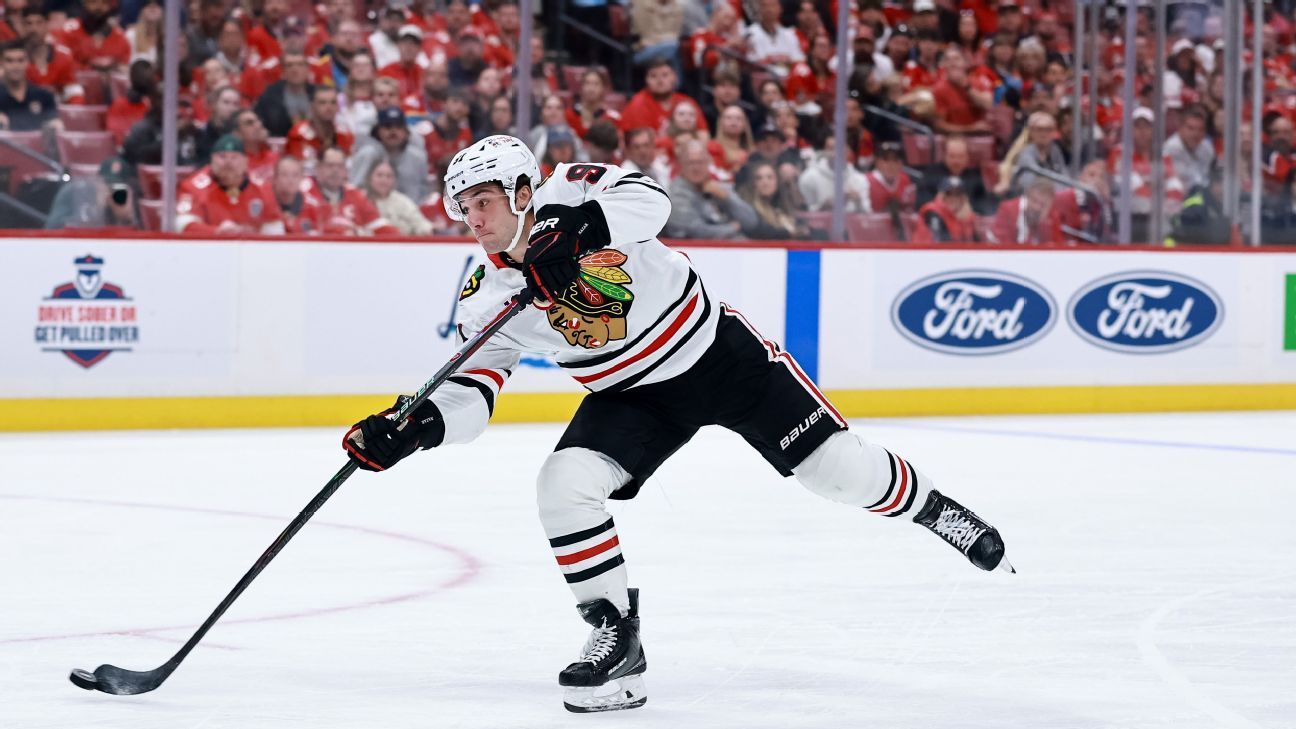
OTTAWA, Ontario — The Chicago Blackhawks lost another key player when Frank Nazar was hit in the face by a puck during Saturday’s 6-4 loss at Ottawa.
Nazar went straight to the locker room after he was struck by Senators defenseman Jordan Spence‘s shot about five minutes into the game. Coach Jeff Blashill declined to offer any specifics about the injury, but he said Nazar will be sidelined for approximately four weeks.
“You saw the play,” Blashill said. “He got hit right in the face.”
Chicago was already without Connor Bedard, who has a team-high 19 goals and 25 assists. Bedard missed his fourth consecutive game with a right shoulder injury that is going to sideline the 20-year-old center at least until early January.
Captain Nick Foligno hasn’t played since Nov. 15 because of a hand injury, but he could return soon.
“One of the things that leads to consistency is depth, and so our depth is getting tested,” Blashill said. “So guys in those roles have to ultimately play at a higher level. As you play more minutes in more important roles, you’ve got to play that much better. And it’s a challenge. And it’s not easy.
“As a group, we need to get more out of more guys. We’ve talked about that, and we’ll continue to talk about that.”
Nazar, who turns 22 on Jan. 14, has six goals and 15 assists in 33 games. The center, a first-round pick in the 2022 draft, agreed to a seven-year contract extension in August.
Chicago and Ottawa were tied at 3 after two periods, but David Perron scored twice in the third for the Senators.
It was the Blackhawks’ fifth consecutive loss. They dropped to 3-11-2 in their last 16 games.

-
Bill Connelly
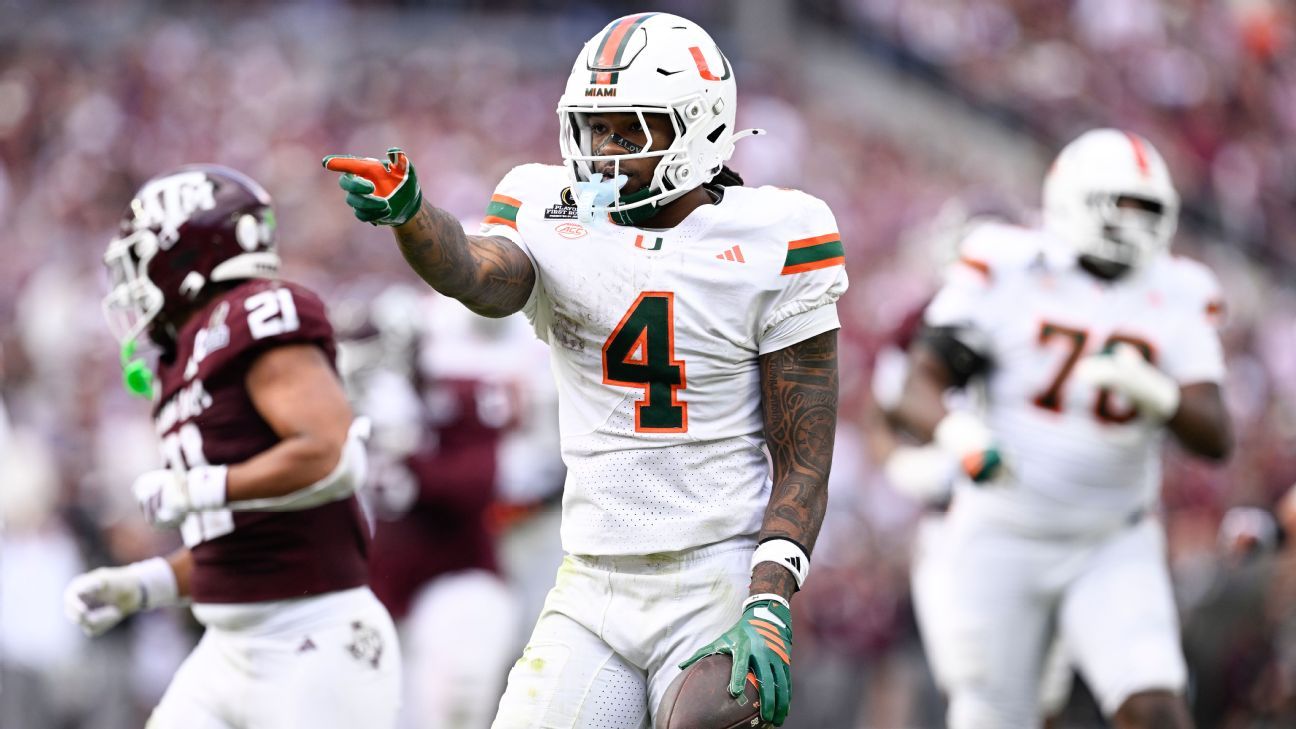
The first round of the 2025 College Football Playoff is complete. After last year’s run of home blowouts, we saw the opposite in the first two games: a pair of nip-and-tuck ballgames with wild special teams swings and, thanks in large part to turnovers, a pair of road victors (after home teams were 4-0 in the first round last year). Alabama pulled off a 17-point comeback to beat Oklahoma 34-24 on Friday night, then Miami survived the ultimate battle of attrition in College Station, beating Texas A&M 10-3.
That wasn’t the case in the final two games. Ole Miss overwhelmed Tulane in their first game without coach Lane Kiffin. Rebels QB Trinidad Chambliss accounted for more than 300 total yards and three touchdowns in the 41-10 victory. Oregon jumped out to a huge first-half lead against James Madison and cruised to an easy 51-34 win.
Here are the main takeaways from the first round.
Jump to a game: JMU-Oregon | Tulane-Ole Miss | Miami-A&M | Bama-OU



What just happened?
Over the past three seasons, Oregon has gone a combined 37-4, with losses only to a national champion (2024 Ohio State), a national finalist (2023 Washington, twice) and the current unbeaten No. 1 seed (Indiana). If you aren’t a genuine title threat, you evidently don’t have a chance against the Ducks, and James Madison most certainly didn’t have a chance Saturday night in Eugene.
The Dukes, making their playoff debut, acquitted themselves well enough on offense, eventually gaining 509 yards and scoring 34 despite leaving a few points on the board with failed red zone opportunities. But their defense, so good within the Sun Belt, got obliterated by an endless early stream of Oregon big-play threats. JMU pulled off a pretty high-wire act in 2025, taking risks, keeping defenders in the box and leaving their perimeter defenders in isolated situations. The Dukes got away with it against Louisville, allowing just 264 yards and 21 offensive points. But Oregon’s offensive line is much, much better than Louisville’s, and JMU couldn’t create any disruption. That only left the big plays. In the first half, the Dukes created zero tackles for loss and gave up five gains of 30-plus yards.
Oregon scored touchdowns on its first five possessions and didn’t punt until midway through the third quarter. Dante Moore made great throws, and when he didn’t, his receivers made great catches as his first 13 completions gained 307 yards. JMU made things annoying in garbage time, gaining 194 fourth-quarter yards and giving Oregon coach Dan Lanning a few things to yell about over the next few days, but the Ducks had this one put away early.
1:02
Dante Moore lets it fly to Malik Benson for a TD
Dante Moore finds Malik Benson to extend Oregon’s lead vs. JMU.
Impact plays
As with Ole Miss-Tulane, when you’re heavily favored and immediately lay the hammer down, “win probability added” isn’t a very helpful concept. But because I’m a completionist, here’s the win probability chart. JMU needed a fast start and got the opposite.
See you next fall, Dukes
The financial gap between mid-majors and the richest power conference programs has grown immensely over the past 15 years or so, and with the upward stream of talent in this transfers-and-NIL universe (not to mention coaches, such as JMU’s UCLA-bound Bob Chesney). It is harder than ever for a Group of 5 team to hint at elite play like Boise State, TCU and Utah did in the late-2000s. (That said, a reminder: The Dukes would have been projected favorites over ACC champions Duke. We still might have gotten a better playoff for its inclusion.)
JMU is built to continue to play at a high level within the Sun Belt, especially with Billy Napier, the author of a particularly physical and impressive run at Louisiana before his tenure at Florida, taking over. But the Dukes got a pretty clear indication of what might await if or when they make another run toward the CFP. Can they raise their game further?
What’s next
When the playoff field was revealed two weeks ago, the first thing that caught my eye was the tantalizing prospect of an Oregon-Texas Tech quarterfinal. Oregon is still relatively new money as far as college football bluebloods go, and Tech is brand spanking new money. They’re both top-four in SP+, and they have done some of the best portal work in the country of late. They will meet in the Orange Bowl early on Jan. 1.
Can Oregon play the same type of precise and ridiculously fast ball against a Texas Tech defensive front that hasn’t been beaten much this season? Can Behren Morton and Tech’s explosive, but inconsistent, offense take what they’re given and avoid forcing the issue too much against an Oregon defense that prevents big plays well and punishes impatience (but did a little too much bending against JMU)? It’s the most interesting quarterfinal matchup.


What just happened?
Ole Miss‘ offense was just too sharp, and Tulane‘s Jake Retzlaff was just too error-prone. In front of a record Vaught-Hemingway Stadium crowd of 68,201, the host Rebels gained 135 yards on their first seven snaps and bolted out to a 14-0 lead. Tulane held up for the rest of the first half and, trailing 17-3 at halftime, had a chance to get back into the game to start the second half. Instead, the Green Wave punted, turned the ball over on downs and lost two fumbles, both by Retzlaff. The Rebels were happy to capitalize on short fields and run up the score.
As his former school, Ferris State, was almost simultaneously winning another Division II national title, Ole Miss quarterback Trinidad Chambliss played an almost perfect game. Despite missing a few snaps with injury at the end of the first half, he completed 23 of 29 passes for 282 yards and a touchdown while gaining 51 yards on four non-sack rushes. Running back Kewan Lacy also missed time with a shoulder injury but returned to the game and finished with 87 yards in just 15 carries, and a deep receiving corps got strong games from three receivers: Deuce Alexander, De’Zhaun Stribling and tight end Dae’Quan Wright combined for 16 catches and 230 yards. Tulane’s offense made far too many mistakes, but it probably wasn’t going to matter: The Rebels were going to score too much regardless.
Impact plays
When you start as the favorite, immediately jump out to a solid lead and don’t really look back, we aren’t going to see many huge plays from a win probability standpoint. But after the Rebels went up 7-0, Tulane put together a solid, 10-play drive in response. But Jaylon Braxton picked off a poor pass from Retzlaff, and after a short return and a horse collar penalty, the Rebels started their second drive at their 40. That popped their win probability up from 87.2% to 91.4%. Four plays later, it was 14-0. Their win probability wouldn’t drop below 91% for the rest of the game.
See you next fall, Green Wave
This was obviously a terribly disappointing finish to the Jon Sumrall era. The newly hired Florida coach led the Green Wave to 20 wins in two seasons, plus a conference title (and wins over Northwestern and Duke) this season. But his team just wasn’t sharp on Saturday. Missed tackles, dropped passes and quarterback mistakes weren’t a good reflection of how well they played down the stretch to secure a bid.
Still, Tulane has positioned itself as one of the strongest programs in the Group of 5. The Green Wave have won 43 games in four seasons, under first Willie Fritz and then Sumrall, and now Will Hall, a former Fritz and Sumrall assistant, takes over. He’ll have to weather the transfer portal raids that come as power conference programs come for successful G5 talent, but the Green Wave are as well positioned as anyone to keep winning.
What’s next
Ole Miss played well down the stretch as rumors swirled around Lane Kiffin’s potential departure, and in their first game post-Kiffin, they were absolutely dynamite. And now they get a chance to avenge their only loss of 2025. In a 43-35 decision at Georgia in Week 8, the Rebels led by nine into the fourth quarter until the Dawgs turned the tables late. Now Ole Miss and Georgia will face off in the Sugar Bowl on Jan. 1.
The key to revenge could be the Ole Miss run defense. Georgia cranked out 221 rushing yards against the Rebels, setting Gunner Stockton up with healthy downs and distances, and he responded by going 26-for-31 for 289 yards and four touchdowns (plus 59 rushing yards of his own). Run defense has been a weakness all season, and Tulane’s Jamauri McClure found some success on Saturday evening, rushing 15 times for 84 yards. Chambliss certainly learned some lessons in Athens, and the Rebels’ offense certainly doesn’t mind a track meet. But forcing the Dawgs off-schedule will be key to an upset and a trip to the semifinals.


What just happened?
Three of the sloppiest, windiest, most war-of-attrition quarters in recent college football history followed by an incredible, dramatic fourth quarter. Miami’s Mark Fletcher Jr. rushed 17 times for 172 yards, and his 56-yard charge with 4:01 left set up the game’s only touchdown, an 11-yard jet sweep from Malachi Toney. It looked as if A&M would force overtime — or score and go for two points and the win — but Bryce Fitzgerald picked off a misplaced Marcel Reed pass in the end zone with 23 seconds left, and the Hurricanes kneeled out a road win.
In a game played in extremely windy conditions, the first three quarters featured more missed field goals (4) than points (3), but a nice run of passes from Reed set up Randy Bond‘s game-tying 35-yarder. Toney’s fumble near midfield with 7:11 left seemed to set the Aggies up for a major opportunity. But Rueben Bain Jr. recorded his third sack of the game to force a punt that set up heroics from Fletcher and redemption for Toney.
0:41
Miami’s INT in end zone seals CFP First Round victory
Marcel Reed makes an inaccurate throw and Bryce Fitzgerald picks it off in the end zone to seal Miami’s win over Texas A&M.
A&M outgained Miami 326-278 and finished six drives in Canes territory, but Reed turnovers ended two of those chances and a missed field goal ended one. Miami didn’t cover itself in glory in this regard, either — six drives finished in A&M territory, producing only two scores — but two scores are greater than one. Quarterback Carson Beck finished the game 14-for-20 for 103 yards and, technically, a touchdown pass off of the jet sweep. But he avoided crucial mistakes and that ended up being a deciding factor. Reed produced more yards (he finished 25-for-39 for 237 yards, plus 27 rushing yards), but the turnovers were devastating.
Impact plays
The win probability chart barely moved over the course of the first three quarters, but it reached 67.1% for A&M following Toney’s fumble. However, some key plays made it lurch in Miami’s direction. As was the case for most of 2025, A&M absolutely owned third downs, going 8-for-18 (44.4%) while holding the Hurricanes to just 3-for-12 (25%). But Toney’s third-down score and Fitzgerald’s third-down pick got the job done.
See you next fall, Aggies
Sometimes you peak a little too early. Texas A&M moved to 9-0 in early November with demonstrative wins over LSU and Missouri, but the Aggies underachieved against SP+ projections by an average of 18.1 points per game over their last four. They needed a huge comeback to beat South Carolina, then scored just 20 combined points in losses to Texas and Miami. The defense had a big-play issue at times — something Fletcher certainly took advantage of — but when you give up 10 total points, you should win every time.
Still, a disappointing finish doesn’t negate the fact that the Aggies were ahead of schedule this fall. Starting Mike Elko’s second season at 19th in the AP poll, A&M won 11 games for the first time since the Johnny Manziel-led 2012 campaign. The Aggies went 12-13 in Jimbo Fisher’s last two years, but Elko is now 19-7, and A&M probably won’t be starting a season 19th or lower for quite a while. Elko will head into 2026 with two new coordinators after defensive coordinator Jay Bateman was allowed to leave for the same position at Kentucky and offensive coordinator Collin Klein took the Kansas State head coaching gig (Elko promoted Lyle Hemphill and Holmon Wiggins, respectively, as replacements). Elko will have to replace some serious talent in the trenches, too, led by star defensive end Cashius Howell. But the passing game comprises primarily underclassmen, and the pass rushing talent doesn’t stop at Howell. Elko’s building job should continue.
What’s next
The Hurricanes meet No. 2 Ohio State in the Cotton Bowl on Dec. 31. With Bain’s incredible play and Miami’s generally fantastic defensive performance, there’s reason to believe they could keep the Buckeyes’ point total tamped down. But Ohio State’s defense is the best in the country; it held Heisman winner Fernando Mendoza and Indiana to 13 points in the Big Ten championship game and has allowed 300 total yards just twice in 13 games. The Buckeyes won’t offer Fletcher the same big run opportunities, so Beck will have to make all the plays he didn’t make Saturday afternoon. Can he?
Those are questions for New Year’s Eve. For now, Miami gets to celebrate its most momentous win since when, 2002? Mario Cristobal’s Hurricanes fell just short of the CFP in 2024 and very easily could have missed out in this go-round as well. But they snagged a bid, and in a windy battle of wills in College Station, they held their nerve and avoided the mistakes that A&M could not. From family members to Michael Irvin, Cristobal was finding too many people to celebrate with to pay much attention to his postgame interview. He can probably be forgiven, huh?


What just happened?
Oklahoma’s offense had only 20 minutes in it. The Sooners were perfect out of the gate, bursting to a 17-0 lead against an Alabama team that looked completely unprepared for the moment. But the Crimson Tide adjusted and rallied, and OU had only a brief answer. From 17 down, Bama outscored its hosts 34-7 from there.
We use the word “momentum” far too much in football, but this was an extremely momentum-based game.
1. Over the first 19 minutes, Oklahoma went up 17-0 while outgaining Bama by a stunning 181-12 margin. It could have been worse, too, as the Sooners’ Owen Heinecke came within millimeters of a blocked punt that might have produced a safety or a touchdown.
2. Over the next 21 minutes, Bama outscored the Sooners 27-0, outgaining them 194-59. Freshman Lotzeir Brooks caught two touchdown passes — the first on a fourth-and-2 to finally get Bama on the board (after he caught a huge third-down pass earlier in the drive), and the second TD came on a 30-yard lob that put the Tide up for good. The Tide defense got pressure on John Mateer, and his footwork and composure vanished. An egregious pick-six thrown directly to Zabien Brown tied the score, and Bama scored the first 10 points of the second half as well.
0:58
Zabien Brown stuns OU with game-tying pick-six before halftime
Zabien Brown takes a big-time interception 50 yards to the house to tie the score before halftime.
OU responded briefly, cutting the margin to three points early in the fourth quarter thanks to a 37-yard Deion Burks touchdown. But the Sooners’ offense couldn’t do enough, and kicker Tate Sandell, the Groza Award winner, missed two late field goal attempts to assure a Bama win.
1:25
Tate Sandell’s back-to-back FG misses help Alabama secure 1st-round win
Tate Sandell misses a pair of late field goals as Alabama holds on to beat Oklahoma 34-24 in the CFP first round.
Impact plays
Oklahoma beat Alabama in Tuscaloosa in November — in the game that eventually certified the Sooners’ CFP bid — thanks to a pick-six and special teams dominance. But the tables turned completely in Norman. Brown’s pick-six was huge, and special teams abandoned the Sooners, both with Sandell’s misses and a botched punt in the second quarter.
The botched punt was the second of a two-part sequence that turned the game against the Sooners. First, Mateer passed up an easy third-and-3 conversion to throw downfield to a wide-open Xavier Robinson, but Mateer short-armed the pass and Robinson dropped it. On the next snap, punter Grayson Miller dropped the ball while moving into his punting motion. Bama’s Tim Keenan III recovered the ball at the OU 30, and though OU’s defense held the Tide to a field goal, what could have been a 24-3 OU lead turned into a 17-10 advantage. That set the table for Brown’s pick-six and everything that followed.
The blown early lead leaves Oklahoma with quite the ignominious feat: In the history of the College Football Playoff, teams are 28-2 with a 17-point lead: OU is 0-2, and everyone else is 28-0. Ouch.
See you next fall, Sooners
We knew that whenever Oklahoma’s season ended, offense would be the primary reason. The Sooners survived playing with almost no margin for error for most of the year. Their No. 49 ranking in offensive SP+ was the worst of any CFP team, but they got enough defense (third in defensive SP+), special teams (21st in special teams SP+) and quality red zone play to overcome it.
The Sooners’ defense still played well Friday night — Bama gained only 260 total yards (4.8 per play) — but the special teams miscues put more pressure on the offense, and after a brilliant start, it ran out of steam. Mateer began the game 10-for-15 for 132 yards with a touchdown, 26 rushing yards and a rushing TD, but his last 31 pass attempts gained just 149 yards with five sacks and the pick, and his last nine non-sack rushes gained just 15 yards.
Brent Venables heads into the offseason facing some decisions. OU’s offense technically improved after the big-money additions of coordinator Ben Arbuckle and Mateer, but Mateer was scattershot before his midseason hand injury and poor after it. Do the Sooners run it back with the same roster core, hoping that better health and a theoretically improved run game can give the defense what it needs to take OU to the next level? Does Venables hit the reset button again? Can he ever get all the arrows pointed in the right direction at the same time?
What’s next
Alabama’s reward for the comeback win is a trip out West: The Tide will meet unbeaten and top-seeded Indiana in the Rose Bowl on Jan. 1. Bama’s defense will obviously face a stiffer test from Heisman winner Fernando Mendoza and the Hoosiers’ attack, but Bama’s defense has been mostly up for the test this season. The Tide’s ability to pull an upset will be determined by Ty Simpson and the Alabama passing game.
Simpson began Friday night’s win just 2-for-6 with a sack, and though he improved from there and didn’t throw any interceptions — his final passing line: 18-for-29 for 232 yards, 2 touchdowns and 4 sacks (6.0 yards per attempt) — his footwork still betrayed him quite a bit during the game, and he misfired on quite a few passes. Oklahoma’s pass rush is fearsome, but Indiana’s defense ranks seventh in sack rate, and with almost no blitzing. The Hoosiers generate pressure and clog passing lanes, and they held Oregon‘s Dante Moore and Ohio State‘s Julian Sayin to 5.1 yards per dropback with 11 sacks, 2 touchdowns and 3 picks. Bama will be an underdog for a reason.
But kudos to the Tide for getting off the mat. They were lifeless at the start, missing tackles and blocks and looking as unprepared as they did in their season-opening loss to Florida State. But Brooks’ playmaking lit the fuse, and Bama charged back.
Just win, baby.
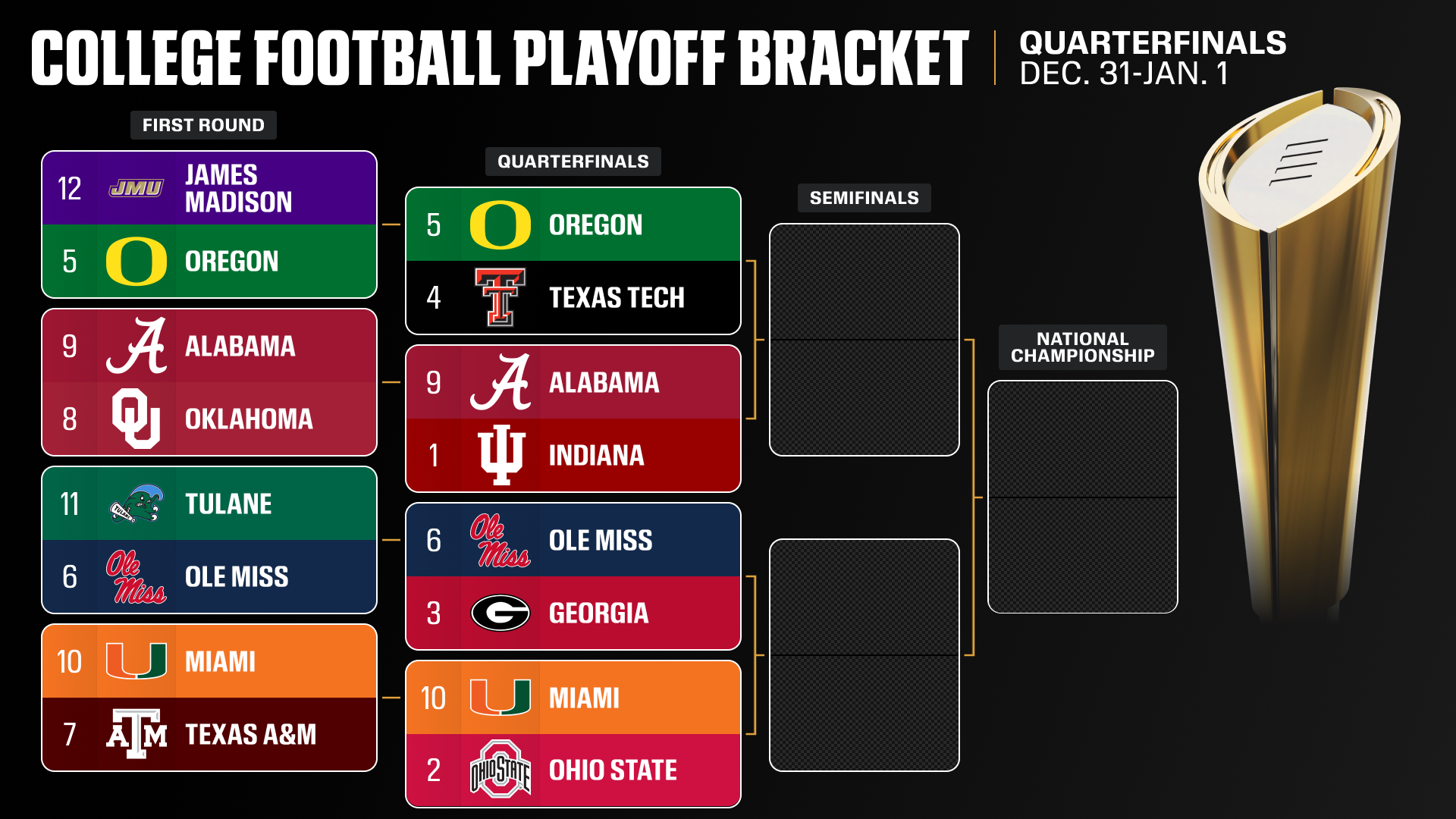
None of the hand-wringing around who should be included in the 12-team playoff matters anymore. All that matters is advancing to the quarterfinals, and three teams have done so already.
Alabama rallied from down 17-0 to beat Oklahoma on Friday, moving on to play top-seeded Indiana in the Rose Bowl.
Then on Saturday, Miami, Ole Miss and Oregon advanced. The Canes beat Texas A&M thanks to an interception in the end zone in the final seconds of the game, and they will play Ohio State in the Cotton Bowl. The Rebels took care of business against Tulane 41-10 and will face Georgia in the Sugar Bowl. The Ducks beat James Madison 51-34 in the final first-round game and will face Texas Tech in the Orange Bowl. The Rose, Sugar and Orange bowls will be played on Jan. 1, with the Cotton Bowl set for Dec. 31.
ESPN’s college football writers are already looking ahead, so here’s a closer look at those quarterfinal matchups.
Jump to:
No. 5 Oregon vs. No. 4 Texas Tech
No. 6 Ole Miss vs. No. 3 Georgia
No.10 Miami vs. No. 2 Ohio State
No. 9 Alabama vs. No. 1 Indiana
When: Jan. 1, noon ET. TV: ESPN
Road to the playoff: Texas Tech had never come close to competing for the College Football Playoff before, but it made all the right moves this offseason and won the program’s first-ever Big 12 title.
Joey McGuire hired two excellent new coordinators in Mack Leftwich and Shiel Wood. General manager James Blanchard and the program’s billionaire benefactors put together an all-time great transfer portal class with 11 new starters who have perfectly complemented the returning talent and culture. They put it all together and then went out and practically steamrolled their schedule.
The Red Raiders won by more than 21 points in every victory this season, finishing with the best scoring margin (552-142) in the FBS. Their exceptional defensive line, led by Lombardi Award winner Jacob Rodriguez, has helped shape one of the best defenses in the country, a unit that is No. 1 against the run and top five in many other metrics. The team’s lone loss came by four points on the road against defending Big 12 champ Arizona State when quarterback Behren Morton was out due to injury.
Player to watch: Morton has been playing through pain for most of this season after suffering a hairline fracture in his right fibula in the opener. The senior aggravated the injury a month later and sat out two games to try to get better before the Big 12 title race. After the Big 12 title game, Morton told ESPN that he was feeling “about 70 percent” healthy and was looking to a first-round bye and three weeks to recover. Losing No. 2 quarterback Will Hammond to a season-ending torn ACL in late October was a setback that has made the week-to-week management of Morton’s injury more challenging.
McGuire calls him the toughest player he has ever coached, and Texas Tech’s title hopes depend on keeping Morton protected and in a good rhythm.
Biggest question: Can Texas Tech’s offense execute at a consistently high level in the red zone? The Red Raiders have played five games against teams that achieved winning records in 2025. They’ve scored touchdowns on just 32% of drives that reached the red zone, totaling 13 field goals and eight touchdowns over 25 opportunities in those games. That percentage vs. winning teams ranks fourth worst in the FBS.
Place-kicker Stone Harrington has had a solid year on field goal attempts (22-of-27), and McGuire clearly trusts him. But this team settled for a total of 11 field goal tries over its two matchups against BYU with two misses in the Big 12 title game.
A lot of factors play into this, including Texas Tech’s trust in its defense. It’ll be interesting to see what solutions Leftwich and his offensive coaches come up with from a playcalling standpoint for finishing drives in the CFP quarterfinals.
They can win if…: Texas Tech’s front seven keeps playing at an elite level. The Red Raiders led the FBS in pressures for most of the season and are also No. 1 in takeaways with 31 after grabbing four more in the Big 12 title game. The defensive line is as good as it gets with three first-team All-Big 12 performers. Rodriguez is enjoying a historic season at linebacker and also won the Butkus Award. His fellow linebackers Ben Roberts and John Curry are having terrific years as well. This team wins with defense and absolutely believes it can compete with the best of the best. In the playoff, that starts with Oregon. — Max Olson
What we learned in Round 1: There wasn’t much new revealed in the Ducks’ 51-34 win against James Madison. The game went about as expected considering the considerable gulf in talent. It reaffirmed, however, that preparations were not meaningfully impacted by offensive coordinator Will Stein (Kentucky) and defensive coordinator Tosh Lupoi (Cal) being named head coaches elsewhere in recent weeks. The Ducks started fast and put the Dukes away early in the first-ever College Football Playoff game at Autzen Stadium.
Player to watch: The marquee player is quarterback Dante Moore, who could be in his final days with the Ducks. Moore has played his way to the top of ESPN NFL draft analyst Mel Kiper Jr.’s 2026 Big Board but has yet to indicate publicly what his future plans are. Against James Madison, Moore led the Ducks to touchdowns on each of their first five drives and finished 19-of-27 for 313 yards with four TDs. He also ran for a score.
They can win if…: They limit the impact of Texas Tech’s front seven. No one in the Big 12 was equipped to deal with how dominant the Red Raiders are up front, and that set the tone almost every week. Oregon has an offensive line that should give Texas Tech its toughest challenge of the season, but — perhaps more importantly — the Ducks have a bunch of speedsters who can make life difficult on the perimeter. Neither of these teams has lost since mid-October, and on paper it might be the most evenly matched game of the quarterfinals. — Kyle Bonagura
When: Jan. 1, 8 p.m. ET. TV: ESPN

Road to the playoff: There were concerns about whether this Georgia team would be as talented as coach Kirby Smart’s championship-winning ones of the past. The Bulldogs didn’t seem to have a high number of potential NFL first-round draft picks, outside of linebacker CJ Allen, and quarterback Gunner Stockton was debuting as the full-time starter.
Yet when the dust settled, the Bulldogs were back in the SEC championship game, where they defeated Alabama 28-7 to win back-to-back conference titles for the first time since Heisman Trophy-winning tailback Herschel Walker led them to three straight in the 1980s. The Bulldogs (12-1) avenged their only loss of the regular season, a 24-21 defeat to the Crimson Tide in Athens on Sept. 27, which ended their 33-game home winning streak. Georgia won its next nine games, including victories over then-No. 5 Ole Miss, then-No. 10 Texas and then-No. 23 Georgia Tech. The Bulldogs won at least 11 games for the eighth time in the past nine seasons under Smart.
Player to watch: Georgia’s offense has mostly been steady with Stockton running the show, averaging 31.9 points and 406.9 yards per game. Receiver Zachariah Branch, a transfer from USC, has been Stockton’s No. 1 option in the passing game. Branch, from Las Vegas, is one of the most explosive players in the FBS. In 12 games, Branch has 73 receptions for 744 yards with five touchdowns. He needs only four catches to break the UGA single-season record of 76, set by Brice Hunter in 1993. A former track star, Branch has the speed and elusiveness to score every time he touches the ball. He makes plays that others don’t, as evidenced by his 13-yard touchdown catch in the SEC championship game when he sidestepped a couple of Tide defenders and then burst into the end zone.
Biggest question: Georgia’s offensive line struggled early but improved throughout the season once key players returned from injury. Then the Bulldogs lost starting center Drew Bobo to a foot injury in their 16-9 victory against Georgia Tech in the regular-season finale. Bobo, whose father is Georgia offensive coordinator Mike Bobo, will miss the CFP because of the injury. Redshirt freshman Malachi Toliver started at center against Alabama in the SEC championship and played well. Toliver, 6-foot-5 and 320 pounds, appeared in five games and made an earlier start against Charlotte. He had a couple of extra weeks to work with Stockton because of the Bulldogs’ first-round bye in the CFP.
Georgia’s offensive line ended up being among the better ones in the SEC. The team ranked third in the league in sacks allowed (18) and fifth in rushing (186.6 yards) after struggling mightily to run the ball in 2024. How well will the line hold up if the Bulldogs end up playing a menacing defensive front such as Miami’s or Texas Tech’s?
They can win if…: Georgia sticks to basics by running the ball and continuing to play tough, physical defense. Defensive coordinator Glenn Schumann caught plenty of flak early in the season when his unit struggled to stop opponents on third down. But the Bulldogs are starting to resemble the defenses that helped them win back-to-back CFP national championships in 2021 and 2022.
In its past four games, Georgia hasn’t allowed more than 81 rushing yards or 274 yards of total offense. Its opponents — Texas, Charlotte, Georgia Tech and Alabama — went a combined 10-for-48 (20.8%) on third down. The Bulldogs forced five turnovers and had nine sacks combined in those contests.
Sophomores Chris Cole (4.5 sacks) and Quintavius Johnson (2 sacks) are getting pressure on the quarterback, and Ellis Robinson IV is living up to his billing as the No. 1 cornerback in the class of 2024 by ESPN Recruiting.
If Georgia can continue to run the ball with Nate Frazier and Stockton, and its defense gets opponents off the field, the Bulldogs will be tough to beat. — Mark Schlabach
What we learned in Round 1: Sure, it was against AAC champion Tulane, which has the worst defense of the 12 teams in the CFP, but the Ole Miss offense came out firing on all cylinders in its first game without coach Lane Kiffin, who left for LSU. Each of Ole Miss’ first five plays went for 20 yards or more, and it scored touchdowns on its first two drives. Things slowed down from there in the second quarter, however, especially after star quarterback Trinidad Chambliss and tailback Kewan Lacy went down with injuries. (They returned in the second half, although Lacy went back to the locker room late in the third quarter.) As long as Lacy isn’t sidelined for long, the offense figures to be fine even without Kiffin on the sideline. — Schlabach
Player to watch: Chambliss. He has been the player to watch over the course of the season, not only for the improbability of his rise but also for the way he has played. Following his ascension to starter, Chambliss became the first SEC player with 300 passing yards and 50 rushing yards in three straight games over the past 30 years. Against Tulane on Saturday, he completed 23 of 29 passes for 282 yards with one touchdown and ran six times for 36 yards with two scores. — Andrea Adelson
They can win if …: The Rebels will need Lacy to be healthy and ready to go against Georgia in 12 days. Ole Miss’ defense figures to get a much more difficult test in New Orleans. The Rebels had a nine-point lead heading into the fourth quarter at Georgia on Oct. 18, but the Bulldogs scored 17 straight points for a 43-35 victory. Georgia bullied the Rebels at the line of scrimmage, controlling the ball for all but 1 minute, 54 seconds. The Bulldogs went 6-for-11 on third down and had 510 yards of offense, including 221 rushing. — Schlabach
When: Dec. 31, 7:30 p.m. ET. TV: ESPN
Road to the playoff: The Buckeyes knocked off then-top-ranked Texas in the opener, then cruised through the schedule, snapping a four-game losing streak to Michigan with an emphatic 27-9 victory in Ann Arbor to cap an undefeated regular season. But in the Big Ten title game, Ohio State came up empty on two second-half drives that ended inside the Indiana 10-yard line as the Hoosiers captured the Big Ten championship with a 13-10 victory. The defending national champion Buckeyes still ended up with the No. 2 seed and a first-round bye. Now, they’ll look to rebound and win back-to-back national titles for the first time in program history.
Player to watch: Quarterback Julian Sayin had the worst game of his career in the Big Ten championship game. He completed 21 of 29 passes for 258 yards and a touchdown but threw an interception on the opening drive and took five sacks as the Buckeyes struggled in the red zone and scored a season-low 10 points. Before that, Sayin had been spectacular in his first season as the starter. He still ranks second nationally with a QBR of 89.6 and owns the best single-season completion rate (78.4%) in FBS history. Will Howard bounced back from a poor performance against Michigan last year to quarterback the Buckeyes to a dominant run through the playoff and a national championship. Sayin has the talent — and supporting cast — to do the same.
Biggest question: Ohio State’s offensive line dominated the opposition for much of the regular season. But when pitted against an elite defensive line in the Big Ten championship game, the Buckeyes faltered up front. The Hoosiers constantly made their way into the Ohio State backfield, racking up nine tackles for loss while limiting the Buckeyes to 87 rushing yards. After ranking in the top 10 in lowest pressure rate allowed (25.8%) during the regular reason — 10th best among Power 4 offensive lines — Ohio State gave up a pressure rate (percentage of dropbacks where the QB was sacked, under duress or hit) of 48.6% in the Big Ten title game (Central Michigan ranked last in the FBS with a pressure rate allowed of 46.2% this season). Can the Buckeyes offensive line respond against the best in the playoff?
They can win if…: Sayin has time to find star wideouts Jeremiah Smith and Carnell Tate downfield. When the Buckeyes do that, they’re virtually unstoppable offensively. Smith and Tate battled lower-body injuries late in the season, which slowed them down a bit, but the time off should help them heal and get closer to 100 percent for the Cotton Bowl. Ohio State’s sensational defense will give the Buckeyes a chance in any matchup. If the passing attack gets back to clicking after the off night in the Big Ten title game, Ohio State can defeat anyone in the playoff, and that includes Miami. — Jake Trotter
What we learned in Round 1: That the Hurricanes belonged in the field. Miami was the last team in, making the College Football Playoff in somewhat controversial fashion, jumping Notre Dame in the final rankings despite both teams not playing in the final week. There were doubters, but Miami made its statement Saturday. In front of the second-largest crowd in playoff history in College Station, Texas, the Canes were poised, efficient and, if not always particularly explosive, they avoided any catastrophic mistakes. Mark Fletcher Jr. answered the critics of Miami’s lackluster run game with 172 yards on the ground, Malachi Toney atoned for a late turnover, and the defense — which likely cost the Canes a playoff spot a year ago — dominated, nabbing three takeaways, including the game-clinching interception in the end zone with 24 seconds left on the clock.
Player to watch: Carson Beck was supposed to be here two years ago, but his playoff dreams burst when Georgia lost to Alabama in the 2023 SEC championship, the Dawgs’ first defeat in three years. He was supposed to be here last year, but an injury in a win over Texas in the SEC title game kept him out of the playoff. He was supposed to be a star Saturday for Miami, but the passing game was mostly absent in the team’s 10-3 win. As the Canes look ahead to Ohio State, there’s only one way they advance, and that will be if Beck plays his best game. He has proved he’s capable. Against A&M, he did just enough to win. In the Cotton Bowl, he’ll need to be special. He’s overdue for that moment.
They can win if…: Miami’s defense was otherworldly against A&M, racking up seven sacks, nine tackles for loss and three takeaways, including a goal-line stand to seal the win. It was an all-time performance at Kyle Field, and the Canes will likely need another one against Ohio State’s high-powered offense. A&M managed just 89 rushing yards, and making the Buckeyes equally one-dimensional will be critical. Then it’s up to a secondary that has been a work in progress at times but that played a nearly flawless game against the Aggies. — David Hale
When: Jan. 1, 4 p.m. ET. TV: ESPN
Road to the playoff: Coach Curt Cignetti and the Hoosiers heard the hate directed at them at the end of their historic 2024 season and decided to run it back and perform even better this fall. Indiana built on its first 10-win season and first CFP appearance by becoming the only FBS team to run the table, posting a 13-0 mark, winning its first outright Big Ten title since 1945 and securing the top seed in the CFP field.
The Hoosiers navigated a much tougher Big Ten schedule than they did in 2024, taking down Oregon, Iowa and Penn State on the road, thumping then-No. 9 Illinois by 53 points in Bloomington and capping things off with a 13-10 win against Ohio State in the Big Ten title game, a matchup that paired the nation’s Nos. 1 and 2 teams.
For all the talk about a soft nonleague schedule, Indiana wasn’t hindered at all, winning all but two of its regular-season Big Ten games by double digits. The Hoosiers finished second nationally in points margin, outscoring their opponents by 404 points. They had to rally against Penn State and Iowa but were unstoppable at home, winning seven games by an average of 40.7 points.
Player to watch: After a team-record 11 wins in 2024, Indiana looked for areas to upgrade, including quarterback, despite Kurtis Rourke’s strong performance (3,042 passing yards, 29 touchdowns). The Hoosiers landed an even more coveted transfer quarterback in Cal’s Fernando Mendoza, who elevated the passing attack even further and became the school’s first Heisman Trophy winner.
Mendoza has delivered four near-flawless performances with more than 85% completions and four or more touchdowns and no interceptions. He occupies the top three spots on Indiana’s single-game completion percentage chart. Mendoza helped rally Indiana for key road wins against Penn State and Iowa and overcame one of his few major mistakes — a pick-six at Oregon — to lead two fourth-quarter scoring drives. Mendoza leads the FBS with 33 touchdown passes, an Indiana single-season record.
Biggest question: There aren’t many weaknesses in Indiana’s profile, as the Hoosiers’ offense and defense ranks in the top 10 nationally in many key statistical categories. But if Indiana wants to advance in the CFP, it likely will face some key fourth-down situations and might need to find greater efficiency. The Hoosiers ended the season 8 of 16 on fourth down, which is tied for 90th nationally and ranks well below other CFP teams such as Texas A&M, Georgia, Ohio State and Alabama. Indiana failed on all three of its fourth-down chances in a 20-15 win at Iowa and went 0-for-1 the following week at Oregon. The good news is IU then became much better on the money down, converting its final five fourth-down attempts, including a fourth-and-2 late in the first half against Ohio State to set up a field goal.
They can win if …: The Hoosiers can successfully execute a balanced offense, as they have for most of the season. Mendoza’s arrival and success have at times overshadowed Indiana’s run game, which is significantly better than it was in 2024. The Hoosiers rank 11th nationally in rushing (221.1 yards per game), up from 63rd last season (165.1). Indiana committed to the run even in lower-scoring games, as it showed against Iowa (39 attempts), Penn State (31) attempts and Ohio State (34 attempts). The offense can’t deviate from that approach against an Alabama defense that defends the run well but doesn’t rank among the nation’s very best. Indiana also is brilliant in the turnover game, tying Texas Tech for the national lead in margin at plus-17. — Adam Rittenberg
What we learned in Round 1: Alabama might not have looked as good Friday night as it did in September and October, but the Crimson Tide still showed it had another gear to kick into en route to matching the largest comeback in CFP history against Oklahoma. Unforced errors crushed the Crimson Tide in their 23-21 loss to the Sooners in November. In the opening round rematch, Alabama flipped the script, storming back from a 17-0 deficit behind Zabien Brown‘s 50-yard pick-six and a disciplined performance from quarterback Ty Simpson, who looked much more like himself two weeks from a disastrous showing in the SEC title game. The Crimson Tide played the kind of (largely) mistake-free football that eluded them over the back half of the regular season. They’ll need to do it again when they meet No. 1 Indiana in the Rose Bowl on New Year’s Day.
Player to watch: With touchdowns on either side of halftime in the first round matchup with Oklahoma, freshman wide receiver Lotzeir Brooks joined some elite company as only the fifth Alabama pass catcher to record two receiving scores in a CFP game. Alongside him on that list: DeVonta Smith (twice), O.J. Howard, Calvin Ridley and Amari Cooper. Brooks caught five passes for 79 yards in his CFP debut, finishing as the Crimson Tide’s leading receiver in the 34-24 win. Within a pass-catching corps that features Germie Bernard, Ryan Williams and Isaiah Horton, Brooks is as dynamic as anyone, and he could be a difference-maker once again against the Hoosiers 19th-ranked pass defense.
They can win if …: Alabama limits its mistakes, and Simpson plays like the Heisman-caliber quarterback we saw over the first half of the season. The Crimson Tide beat Oklahoma at its own game in the first round, forcing quarterback John Mateer into timely errors and pouncing on miscues such as Grayson Miller‘s bobbled punt attempt before halftime. Couple that with composed, accurate quarterback play from Simpson, and the Crimson Tide have the tools to give Indiana trouble. — Eli Lederman
-
 Sports2 years ago
Story injured on diving stop, exits Red Sox game
-
 Sports3 years ago
‘Storybook stuff’: Inside the night Bryce Harper sent the Phillies to the World Series
-
 Sports2 years ago
Game 1 of WS least-watched in recorded history
-
 Sports3 years ago
Button battles heat exhaustion in NASCAR debut
-
 Sports3 years ago
MLB Rank 2023: Ranking baseball’s top 100 players
-
Sports4 years ago
Team Europe easily wins 4th straight Laver Cup
-
 Environment3 years ago
Japan and South Korea have a lot at stake in a free and open South China Sea
-
 Environment1 year ago
Here are the best electric bikes you can buy at every price level in October 2024