
‘Now everybody sees it’: How Adolis Garcia learned to shine on the biggest stage


-
Alden Gonzalez, ESPN Staff Writer
ARLINGTON, TEXAS — They barreled out of the first-base dugout in a flash, congregating around home plate so quickly that Texas Rangers outfielder Evan Carter said they might have arrived there even before Adolis García reached first base.
It was almost as if they’d anticipated another moment like this.
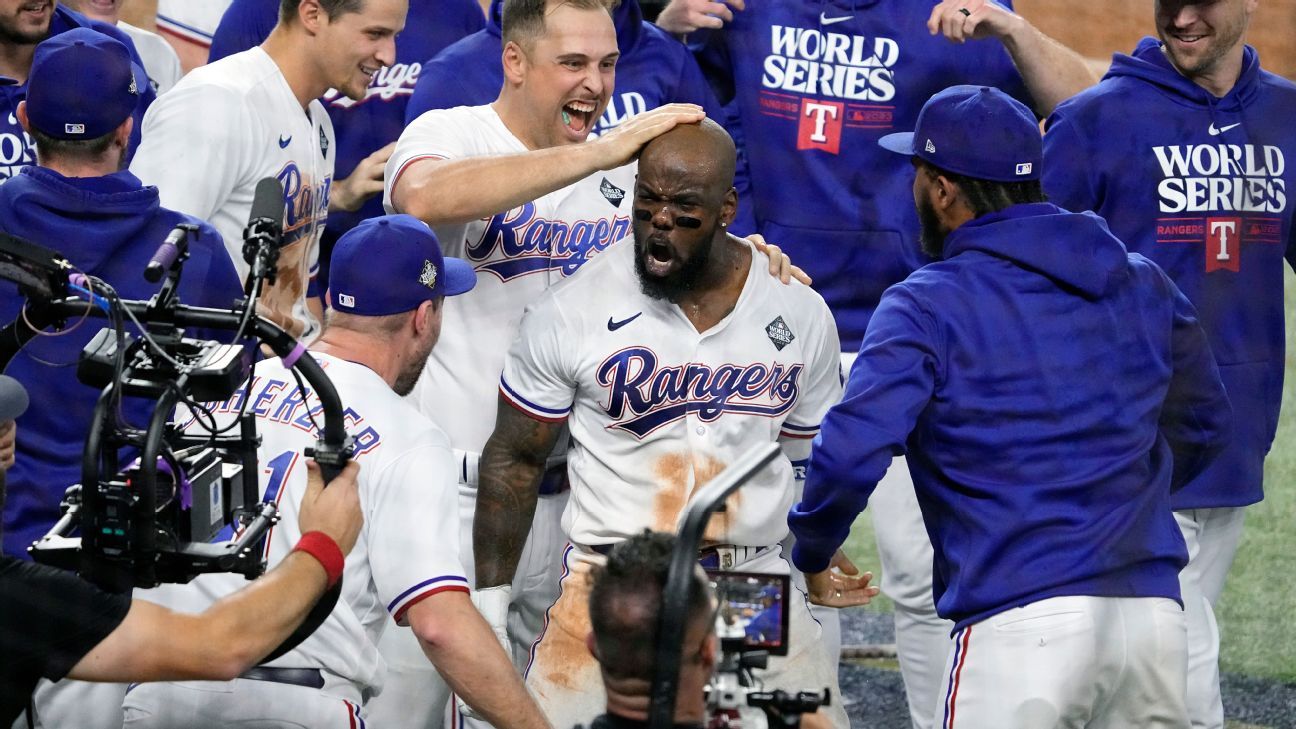
After bursting onto the scene in the summer of 2021, García has spent the fall of 2023 putting together one of the most captivating postseason performances in baseball history, dazzling with his glove and his legs and, mostly, his bat. When he settled into the batter’s box in the 11th inning of the opening game of this Fall Classic on Friday night, his teammates — really, all of Globe Life Field — seemed to expect something. What followed was the first walk-off home run in Game 1 of the World Series since Kirk Gibson’s legendary drive in 1988.
This is the type of legacy García is building.
“I don’t think I ever imagined that these types of things would be happening to me,” said García, speaking in Spanish, moments after sealing the Rangers’ 6-5 victory over the Arizona Diamondbacks. “But I’m very grateful and happy, and I’m just going to keep giving it my best to help us win it all.”
García, 30, has homered in five consecutive playoff games, one shy of the major league record. His total for the postseason is now at eight, just two fewer than the 2020 output from Randy Arozarena, his minor league roommate and best friend. That walk-off home run was his 22nd RBI this postseason, breaking the all-time record set by David Freese, the former St. Louis Cardinals third baseman, during a 2011 run that famously left Rangers fans devastated.
“When he gets hot, it’s really hot,” Rangers second baseman Marcus Semien said of García. “Now everybody sees it.”
García almost single-handedly ended the Houston Astros‘ season in the American League Championship Series, then proceeded to reach base in four of his first five plate appearances to begin the World Series. He singled in the first, drew a walk in the third, added another single in the eighth and took a 92 mph fastball to his left hand from D-backs closer Paul Sewald in the ninth, moments after Corey Seager tied the score with a 418-foot two-run homer.
García shook it off, promptly stole second base and came to bat again two innings later, with none on, one out and the score still tied. Right-handed reliever Miguel Castro fed him a steady diet of changeups, the one pitch that gave him trouble this season, but fell behind in the count 3-1. He followed with a 97 mph sinker slightly low, which García drove to the opposite field and lofted over the right-field fence, sending a sold-out Globe Life Field crowd into a frenzy.
Rangers first baseman Nathaniel Lowe doused García with a cooler of iced water as he approached home plate. In the tunnel on the way to the clubhouse, teammates repeatedly chanted his nickname — “Bombi,” originally given to García by a childhood friend who thought his head was shaped like a light bulb.
It was six years ago that García left friends and family behind in Cuba and went to Japan as a springboard to come to the United States and fulfill his dream of reaching the majors. He signed for a relatively small amount, was passed over twice — including by the Rangers. He didn’t carve out a full-time role in the big leagues until he neared the end of his 20s. But he always believed moments like these were possible.
“I think it’s all been worth it,” García said. “If I had to do it all over again, I would, because I feel so grateful for everything that has happened.”
NATHANIEL LOWE’S DAY was finished. It was March 24, 2021, eight days before the start of the Rangers’ regular season. Lowe had taken his three at-bats in a Cactus League game and he was officially off the clock.
But Adolis García continued to grab his attention.
Lowe had come to the Rangers’ organization from the Tampa Bay Rays that offseason, and he spent the weeks of spring training familiarizing himself with his new teammates. García immediately caught his eye — and mystified him. García, then 28 and headed for the Triple-A club, was stealing bases and turning in highlight-reel plays and hitting baseballs harder than anybody else. Lowe couldn’t understand why he wasn’t on the roster.
On that day, Lowe had finished changing in the visitors clubhouse and readied to leave. When he heard García’s name being announced as a late-game substitution, he paused, peering through a peephole that looked onto the field. García was coming in for one of the regulars with the Rangers trailing in the ninth inning of a meaningless game, as is often the case for those unlikely to reach the major leagues — and he scorched a two-run double to capture a victory. Lowe could only shake his head. García once again looked like the best player on the field.
“It felt like every ball he hit, he just hammered it off the wall — again and again and again,” Lowe recalled.
What Lowe saw in just a few weeks was something that it took multiple major league franchises years to understand.
When García defected from Cuba in summer 2016 — he had already had an MVP season for Serie Nacional, the country’s professional league, and a brief stint with the Yomiuri Giants of the Japan Eastern League — he was nearing his 24th birthday, relatively old for an international signee. The St. Louis Cardinals signed him for $2.5 million in February 2017, bouncing him between Double-A and Triple-A, plus a cup of coffee in the majors, before designating him for assignment in December 2019. The Rangers immediately picked him up, then designated him for assignment in February 2021 after signing a starting pitcher named Mike Foltynewicz. García slipped through waivers unclaimed and was outrighted off the 40-man roster.
By that point he was almost 28, coming off a COVID-shortened season that shut down the minor leagues and limited him mostly to workouts at the Rangers’ alternate training facility. His major league career consisted of 23 at-bats and two hits.
Unbridled optimism carried him.
“I knew what I could do, what level of baseball I could play at,” García said. “I always had confidence in that. I just kept working because I knew this team was going to give me the opportunity. I just needed to take advantage of it.”
García surged through spring training in 2021, slugging .781 in 22 games, but the Rangers left him off their Opening Day roster. It wasn’t until Ronald Guzman suffered a torn meniscus in his right knee on April 12 that García was finally called up.
Four days later, he won a game in extra innings with his first career home run. In May, he was named the AL Rookie of the Month. In July, he was an All-Star. By the end of the year, he had become a fixture on a rebuilding Rangers team that lost 102 games and was scrounging to identify core players to build around.
“He was still a developing player, and I think the question we had is if he was consistent enough to be a good major league player at that point,” Rangers general manager Chris Young said. “And I think, honestly, where we were as an organization, we had the ability to give him the runway to work through those things. And as he got opportunities, we saw a player with extreme aptitude, a player with incredible work ethic — an energy, a passion for excellence and continual improvement. He’s made himself into the player he is now.”
THE END OF the 2022 season prompted a sit-down between García and the Rangers’ hitting experts, a group that consists of offensive coordinator Donnie Ecker, hitting coach Tim Hyers and assistant hitting coach Seth Conner. The meeting revolved around two key questions:
What do people think of Adolis García?
What do you want them to think of Adolis García?
At that point, García had put together back-to-back solid major league seasons, accumulating 58 home runs and 41 stolen bases while OPS’ing .749 through a stretch of 305 games. But he continued to carry a reputation as an all-or-nothing hitter, the type of label that had soured major league teams in the first place.
From 2017 to 2019, García had accumulated 366 strikeouts in 368 minor league games, a stretch in which he walked less than 5% percent of the time. Breaking balls in particular bothered him. The Rangers spent a sizable chunk of 2020 remaking García’s swing, incorporating a toe-tap to keep him more lateral and eliminating excess movement to help shorten his swing path. But his first two major league seasons still saw him rank just outside the bottom 10% in chase rate and finish 260th among 297 qualified players in walk percentage. García needed to learn to work counts, lay off breaking balls and force opposing pitchers to throw into his preferred zone.
So after that conversation with Ecker and the Rangers team, almost as soon as the 2022 season concluded, García went to Tampa, Florida, to work with his personal hitting coach, Osvaldo Diaz, a former minor leaguer from Cuba.
Together, they decided to change the answer to Ecker’s first question.
“It was very personal to him — ‘pitchers are going to fear me, and they’re going to respect me,'” Ecker said. “Credit to them. They did the work on that, and then he came in and he executed it. Adolis is a special human, and there’s nothing he wants to do that’s average.”
The 2023 regular season saw García set career highs in home runs (39), RBIs (107) and OPS (.836) while making his second All-Star team. He still struck out a healthy amount — 175 times in 148 games — but he also drew 65 walks, just seven fewer than his combined total from 2021 and 2022. From one year to the next, his chase rate dropped from 37% to 29.4%, an uncommon improvement for a hitter already in his 30s.
Along the way, García learned to better analyze video of opposing pitchers, a skill that has paired nicely with an innate ability to make in-game adjustments.
“It’s pretty cool,” Ecker said. “For his age, he’s really in Year 3. He’s figuring out the game, he’s figuring out Major League Baseball, and it’s pretty special that in Year 3 he’s making these types of strides. It’s kind of scary what could be possible for this guy.”
YOUNG HAD NEVER seen a player get booed so roundly. Before running the Rangers’ baseball-operations department, Young spent 14 years pitching in the major leagues. He played two seasons in New York from 2011 to 2012 and made a World Series run with the Kansas City Royals in 2015. Through it all, he had never experienced anywhere near as much animosity toward a visiting player as what greeted García for Games 6 and 7 of the ALCS from Minute Maid Park in Houston, in the wake of the benches-clearing incident that centered around him getting drilled by a Bryan Abreu fastball.
García proceeded to strike out in each of his first four at-bats, and the vitriol escalated further with each one. He found himself too eager.
“I wanted to get the big hit; that’s all I wanted to do,” García said. “But I told myself, ‘No, you need to calm yourself down and just do your best.'”
What followed was one of the best surges in recent memory. In a string of six at-bats over the next two games — at a time when his team needed back-to-back road wins to knock off the defending-champion Astros and reach the World Series — García accumulated five hits, three of which were home runs (it would’ve been four had his first-inning double in Game 7 sailed a couple of feet higher). He drove in nine runs in that stretch, solidifying ALCS MVP honors while setting a record for RBIs in a single postseason series with 15.
In a highly contentious environment, with more than 40,000 people openly rooting for his failure, García found a way to extract his best self.
It captured his essence.
“I think some of the best players have a little bit of that ‘f— you’ mentality,” Rangers left-hander Andrew Heaney said. “They don’t care what other people think; they don’t take into account other people’s opinions. I think he has that ability. I don’t know how much he’s shutting out the noise versus absorbing it and letting it fuel him, but I think either way, you’re still going, ‘F— these guys. I’m gonna show them.'”
Later, in the champagne-soaked clubhouse he helped ignite, teammates gushed about García’s performance and how it spoke to his distinctive traits. One raved about his supreme talent but brought up the unwavering confidence that allows it to spill out so routinely in pressure-packed moments. Another laughed that an entire country is now learning about the greatness they had long realized. Others noted that MLB should market García as one of its transcendent stars, up there with the likes of Shohei Ohtani and Ronald Acuna Jr. He has the skill set, but also the swagger.
“It’s so good for young players to watch him and how he plays with such confidence to just prove stuff to everybody else,” Semien said. “I think a lot of young players can learn from that guy.”
García said he took the animosity in Houston as a “positive — knowing that there was an entire stadium that was focused on me.” He viewed it as an opportunity, not a burden. In recent years, García has learned to quiet the outside noise and simplify his concentration. The tail end of the ALCS proved to him that he could do it on the grandest of stages.
Which, of course, meant he could do it in Game 1 of the World Series, too.
“I only have three years playing in the big leagues, but I’ve had a long baseball career in general and I’ve been through a lot during that time,” García said. “That’s why moments like that don’t get me stressed out.”

-
Bill Connelly
The 2025 College Football Playoff got underway in Norman, Oklahoma, on Friday night, and we’ve already seen a first. After all four home teams won by demonstrative margins in last year’s first round, Alabama became the first road team to prevail in a playoff game with a stirring comeback against Oklahoma and a 34-24 win.
Here are the main takeaways. We will update this with each completed game.



What just happened?
Oklahoma’s offense only had 20 minutes in it. The Sooners were perfect out of the gate, bursting to a 17-0 lead against an Alabama team that looked completely unprepared for the moment. But the Crimson Tide adjusted and rallied, and OU had only a brief answer. From 17 down, Bama outscored its hosts by a 34-7 margin from there.
We use the word “momentum” far too much in football, but this was an extremely momentum-based game.
1. Over the first 19 minutes, Oklahoma went up 17-0 while outgaining Bama by a stunning 181-12 margin. It could have been worse, too, as the Sooners’ Owen Heinecke came within millimeters of a blocked punt that might have produced a safety or a touchdown.
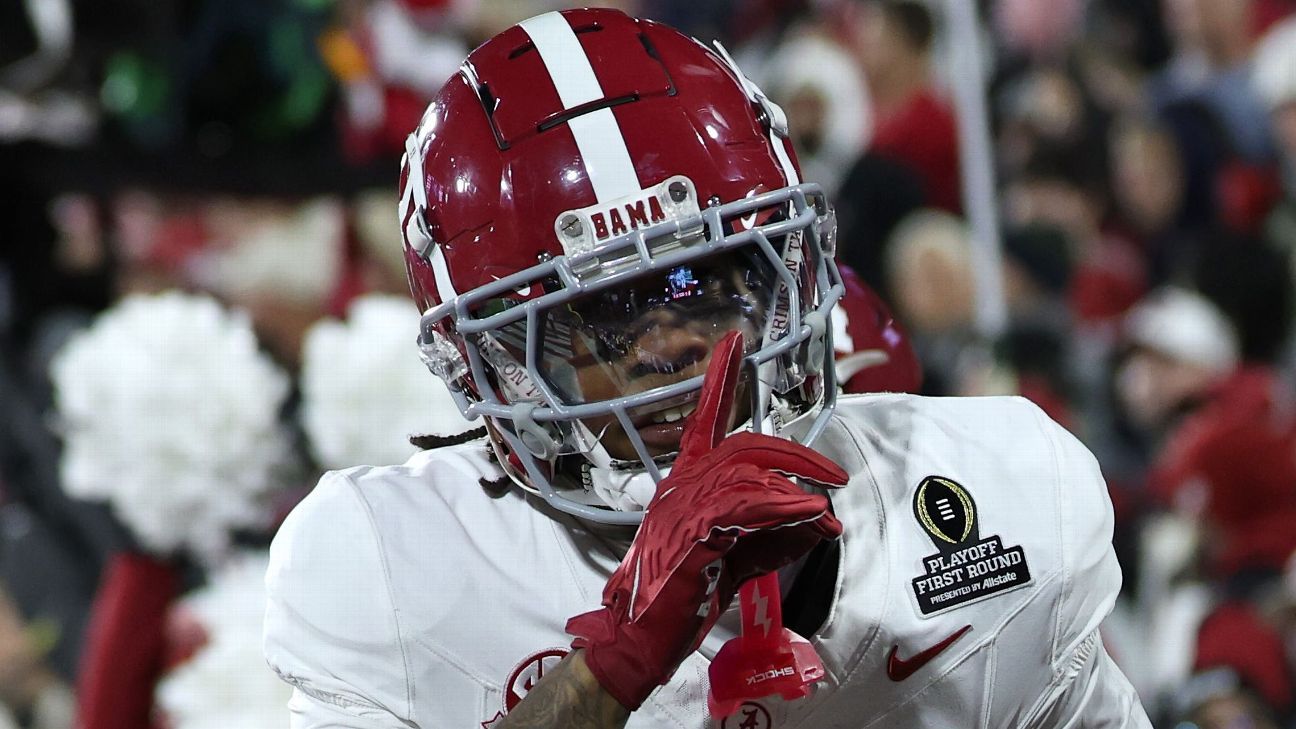
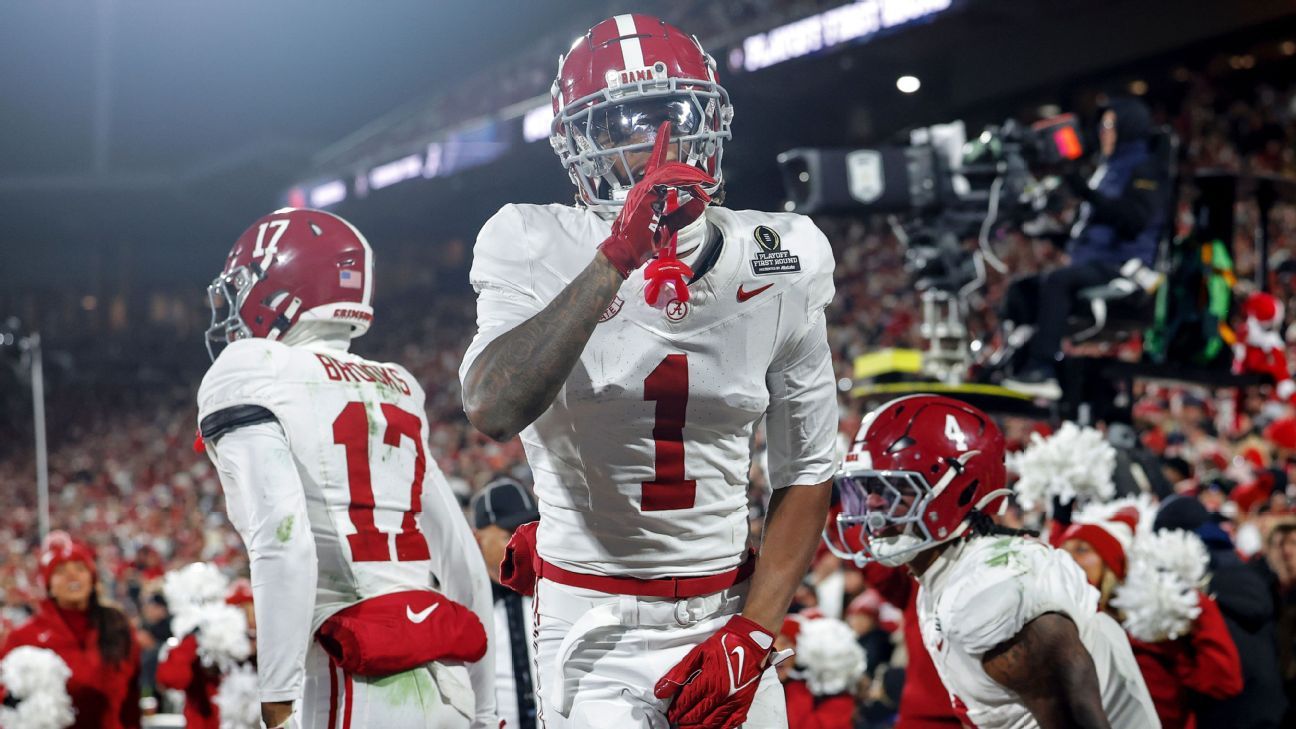
2. Over the next 21 minutes, Bama outscored the Sooners 27-0, outgaining them, 194-59. Freshman Lotzeir Brooks caught two touchdown passes — the first on a fourth-and-2 to finally get Bama on the board (after he caught a huge third-down pass earlier in the drive), and the second TD came on a 30-yard lob that put the Tide up for good. The Tide defense got pressure on John Mateer, and his footwork and composure vanished. An egregious pick-six thrown directly to Zabien Brown tied the game, and Bama scored the first 10 points of the second half as well.
0:58
Zabien Brown stuns OU with game-tying pick-six before halftime
Zabien Brown takes a big-time interception 50 yards to the house to tie the score before halftime.
OU responded briefly, cutting the margin to three points early in the fourth quarter thanks to a 37-yard Deion Burks touchdown. But the Sooners’ offense couldn’t do enough, and kicker Tate Sandell, the Groza Award winner, missed two late field goals to assure a Bama win.
1:25
Tate Sandell’s back-to-back FG misses help Alabama secure 1st-round win
Tate Sandell misses a pair of late field goals as Alabama holds on to beat Oklahoma 34-24 in the CFP first round.
Impact plays
Oklahoma beat Alabama in Tuscaloosa in November — in the game that eventually certified the Sooners’ CFP bid — thanks to a pick-six and special teams dominance. But the tables turned completely in Norman. Brown’s pick six was huge, and special teams completely abandoned the Sooners, both with Sandell’s misses and with a botched punt in the second quarter.
The botched punt was actually the second of a two-part sequence that turned the game against the Sooners. First, Mateer passed up an easy third-and-3 conversion to throw downfield to a wide open Xavier Robinson, but he short-armed the pass and dropped it. On the very next snap, punter Grayson Miller dropped the ball moving into his punting motion. Bama’s Tim Keenan III recovered the ball at the OU 30, and while OU’s defense held the Tide to a field goal, what could have been a 24-3 OU lead turned instead into a 17-10 advantage. That set the table for Brown’s pick-six and everything that followed.
The blown early lead leaves Oklahoma with quite the ignominious feat: In the history of the College Football Playoff, teams are 28-2 with a 17-point lead: OU is 0-2, and everyone else is 28-0. Ouch.
See you next fall, Sooners
We knew that whenever Oklahoma’s season ended, offense would be the primary reason. The Sooners survived playing with almost no margin for error for most of the year. Their No. 49 ranking in offensive SP+ was the worst of any CFP team, but they got enough defense (third in defensive SP+), special teams (21st in special teams SP+) and quality red zone play to overcome it.
The Sooners’ defense still played well on Friday night — Bama gained only 260 total yards (4.8 per play) — but the special teams miscues put more pressure on the offense to come through, and after a brilliant start, it ran out of steam. Mateer began the game 10-for-15 for 132 yards with a touchdown, 26 rushing yards and a rushing TD, but his last 31 pass attempts gained just 149 yards with five sacks and the pick, and his last nine non-sack rushes gained just 15 yards.
Brent Venables therefore heads into the offseason with some decisions to make. OU’s offense technically improved after the big-money additions of coordinator Ben Arbuckle and Mateer, but Mateer was scattershot before his midseason hand injury and poor after it. Do the Sooners run it back with the same roster core, hoping that better health and a theoretically improved run game can give the defense what it needs to take OU to the next level? Does Venables hit the reset button again? Can he ever get all the arrows pointed in the right direction at the same time?
What’s next
Alabama’s reward for the comeback win is a trip out West: The Tide will meet unbeaten and top-seeded Indiana in the Rose Bowl on January 1. Bama’s defense will obviously face a stiffer test from Heisman winner Fernando Mendoza and the Hoosiers attack, but Bama’s defense has been mostly up for the test this season. Their ability to pull an upset will be determined by Ty Simpson and the Alabama passing game.
Simpson began Friday night’s win just 2-for-6 with a sack, and while he improved from there and didn’t throw any interceptions — his final passing line: 18-for-29 for 232 yards, two touchdowns and four sacks (6.0 yards per attempt) — his footwork still betrayed him quite a bit over the course of the evening, and he misfired on quite a few passes. Oklahoma’s pass rush is fearsome, but Indiana’s defense ranks seventh in sack rate itself, and with almost no blitzing whatsoever. The Hoosiers generate pressure and clog passing lanes, and they held Oregon‘s Dante Moore and Ohio State‘s Julian Sayin to 5.1 yards per dropback with 11 sacks and two touchdowns to three picks. Bama will be an underdog for a reason.
That said, kudos to the Tide for getting off the mat. They were lifeless at the start, missing tackles and blocks and looking as unprepared as they did in their season-opening loss to Florida State. But Brooks’ play-making lit the fuse, and Bama charged back.

-
Greg Wyshynski
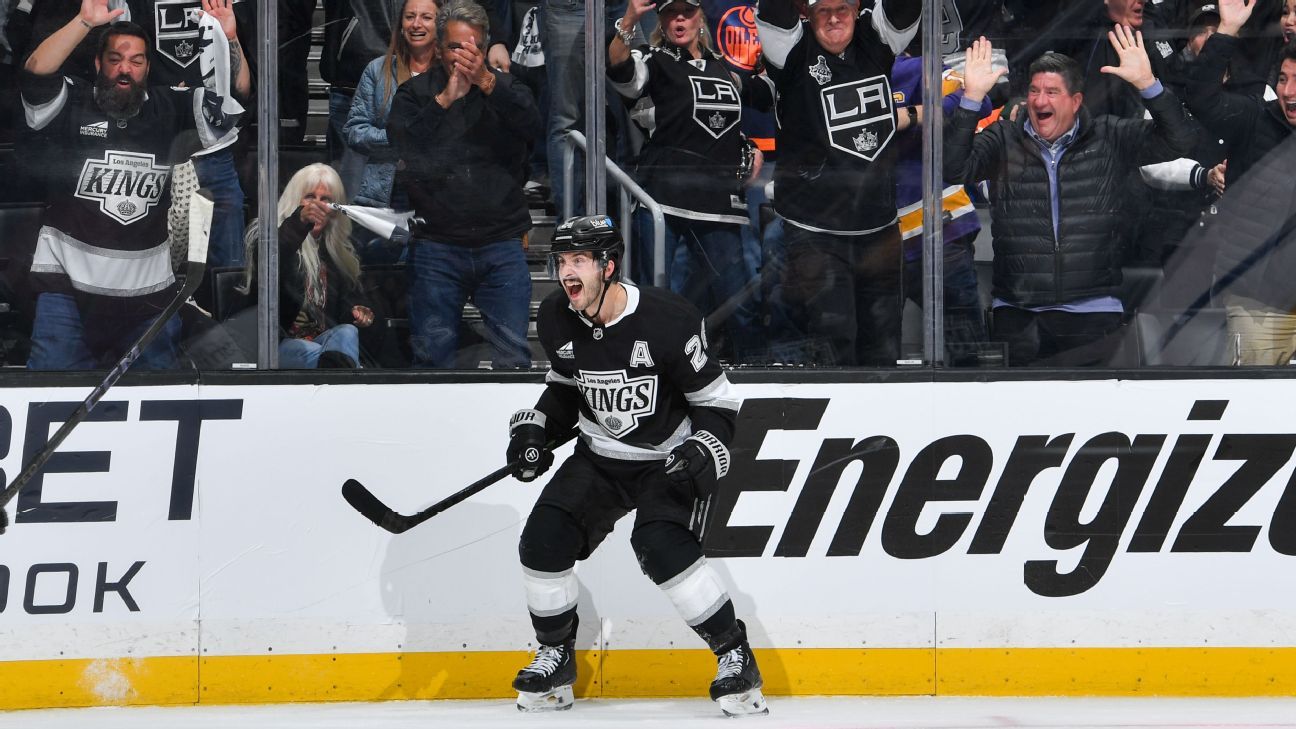
The Los Angeles Kings traded center Phillip Danault to the Montreal Canadiens on Friday, ending speculation about his future with the team.
Montreal sent a 2026 second-round draft pick, which originally belonged to the Columbus Blue Jackets, to the Kings.
Danault, 32, is in his 12th season in the NHL. He was in his fifth season with the Kings. He played for the Canadiens from 2016 to 2021 before leaving as a free agent, signing a six-year, $33-million deal with Los Angeles. He is signed through the 2026-27 season with a $5.5 million cap hit.
Danault has zero goals and five assists in 30 games this season. He has appeared in 741 career NHL regular-season games and totaled 125 goals and 274 assists for 399 points with the Kings, Canadiens and Chicago Blackhawks (2014-16). Danault is primarily known for his defensive prowess, winning 52.9% of his faceoffs this season.
There was speculation around the NHL surrounding Danault’s future with the Kings. He averaged 16:19 in ice time per game, which was down significantly from last season (17:40). An NHL source indicated that “a change in scenery” was likely in order.
The deal happened on the eve of the NHL’s holiday roster freeze, which takes effect at midnight ET on Saturday and lifts Dec. 28.
-
 Sports2 years ago
Story injured on diving stop, exits Red Sox game
-
 Sports3 years ago
‘Storybook stuff’: Inside the night Bryce Harper sent the Phillies to the World Series
-
 Sports2 years ago
Game 1 of WS least-watched in recorded history
-
 Sports3 years ago
Button battles heat exhaustion in NASCAR debut
-
 Sports3 years ago
MLB Rank 2023: Ranking baseball’s top 100 players
-
Sports4 years ago
Team Europe easily wins 4th straight Laver Cup
-
 Environment3 years ago
Japan and South Korea have a lot at stake in a free and open South China Sea
-
 Environment1 year ago
Here are the best electric bikes you can buy at every price level in October 2024