
Winners and losers of Connor McDavid’s contract extension


-
Greg Wyshynski
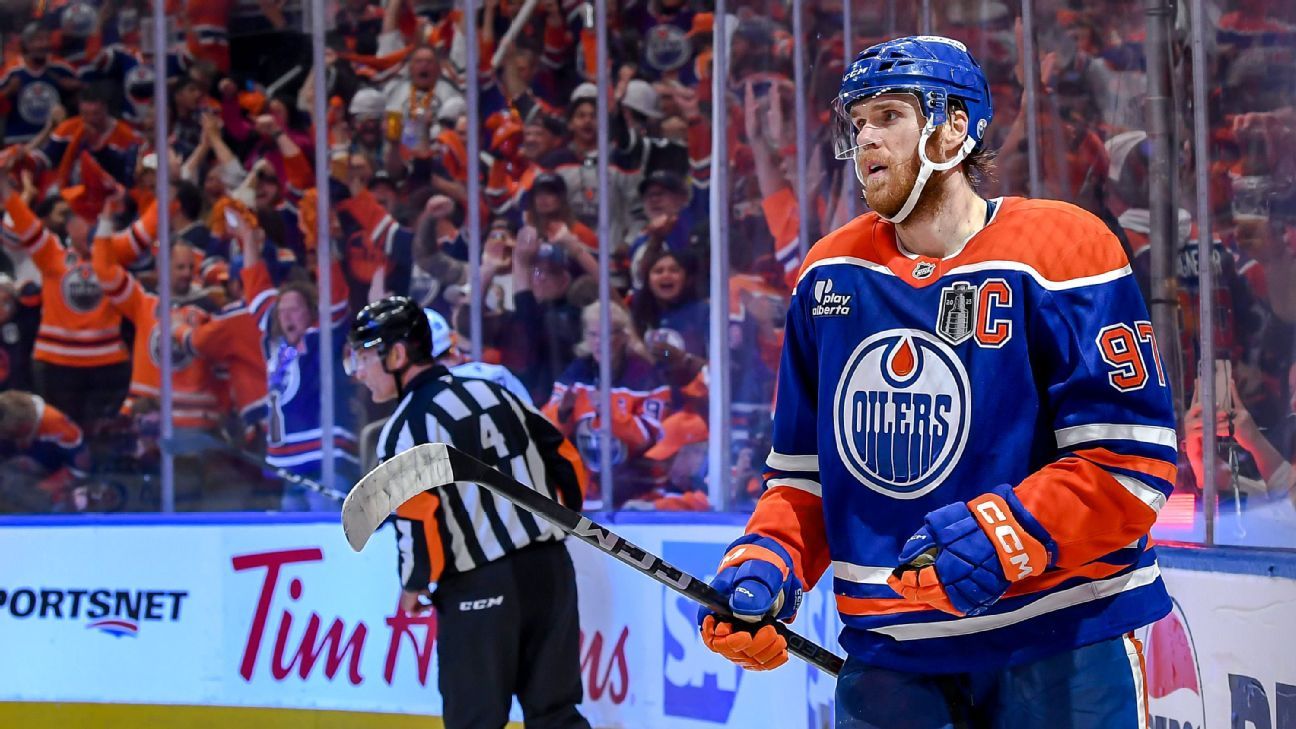
Connor McDavid responded to months of speculation by signing a contract extension with the Edmonton Oilers on Monday.
Notice how we didn’t say that he “ended” that speculation: McDavid’s contract, which carries an extremely team-friendly $12.5 million average annual value, is only for two years beyond this one, meaning the best hockey player in the world could still become the most coveted free agent in NHL history in summer 2028.
But if you’re the Oilers, you’re taking the glass-half-full approach. Or more to the point, a half-full (Stanley) Cup: Connor McDavid has at least three more chances to bring the first championship since 1990 to Edmonton.
As with any significant decision in the NHL, there are winners and there are losers.
Here’s the fallout from Connor McDavid’s new contract:
WINNER: Connor McDavid
Since it’s only a two-year extension, McDavid will have a slew of questions about why he chose that term and what it means for his ultimate future in Edmonton. But then after those questions are asked and answered, McDavid will focus on winning a Stanley Cup in Edmonton and a gold medal for Canada this season without being burdened with speculation. With this season and then two more, those questions can wait until at least September 2027.
This deal was done before the first puck was dropped on the NHL season, and one has to assume Connor wanted it that way.
With McDavid’s contract situation settled, the entirety of the rumor mill will now focus on Crosby’s future with the Pittsburgh Penguins.
It’s a topic that Crosby is already sick of discussing but one that’ll grow in volume with each Penguins loss — and the pundits are predicting a lot of Penguins losses this season.
At least McDavid’s pending unrestricted free agency lured some of that spotlight away from Sid. Now, he’s the primary fuel source for this season’s rumor industry.
WINNER: Edmonton fans
When Oilers fans would say that McDavid wasn’t going anywhere, it sounded more aspirational than emphatic.
Maybe this season would be the last shot. Maybe he desired to play for one of the NHL’s glamour franchises, or one he felt had a longer contention window than Edmonton’s.
Visions of teary-eyed news conferences of the past filled their memories, like that time the other greatest player in franchise history ended up being The Great One in Los Angeles — heck, the Kings were even one of the teams that had the cap space ready for Connor next summer.
But he chose Edmonton. Not for the long term — at least not now — but he chose Edmonton. To continue living there. To continue playing there. Because he wanted to bring a championship there.
LOSERS: Everyone else
No McDavid rumor mill. No McDavid free agency frenzy. No McDavid arriving in New York or Dallas or Los Angeles or Tampa Bay or (gasp) Toronto to elevate those teams into immediate Stanley Cup favorite status. No hearing the faint sounds of the “Imperial March” as we tuned in to watch McDavid taking his talents from Edmonton to the highest bidder.
Yes, the smart money was always on him staying in Edmonton. It doesn’t mean the rest of us can’t be a little bummed that he left all that fun on the table — along with over $100 million in free agent riches.
WINNER: Stan Bowman
McDavid decided on Monday that he wanted to ink a two-year extension with the Oilers. That was after months of contemplation about whether — and if so, for how long — he wanted to commit to Edmonton. Part of that process was sitting down with Bowman to hear the GM’s plans for the Oilers moving forward. Ultimately, they got him to remain an Oiler for a few more runs at the Stanley Cup.
Now, one could say that the pitch enticed McDavid to remain with the Oilers for only two more seasons beyond this one, which might not say much for its effectiveness. And one could say that McDavid having essentially given Bowman money out of his pocket to spend should empower the player to have more say in organizational decisions. But, c’mon, no franchise player has that kind of pull within the organization.
On an unrelated topic: Congratulations to Oilers’ coach Kris Knoblauch, who coached McDavid in juniors, on his new contract, given to him by Jeff Jackson, who is CEO of hockey operations and used to be McDavid’s agent.
LOSER: The Oilers’ runway
Now comes the hard part: Building a team around McDavid and fellow Oilers star Leon Draisaitl that can finally celebrate a Stanley Cup championship; or, failing that, one that convinces McDavid that the future in Edmonton is bright enough for him not to take his stuff and leave in 2028.
There’s frankly a better chance of the former happening than the latter.
The defending Western Conference champs bring back most of the same roster as last season, although the loss of Corey Perry might doom their Stanley Cup Final karma. After that, Bowman has some decent money coming off a rising cap next summer, including both goaltenders.
McDavid is essentially Uncle Jimmy in Season 4 of “The Bear,” slamming down a countdown clock until the restaurant is a success or goes bust. Bowman will spend the next three years frantically pawing at ingredients to find the right recipe.
WINNER: GM empowerment
Every NHL general manager has, at some point, tried to sell a player with an expiring contract on taking a little less to help the team in a salary-capped league. Most times, that player will absolutely refuse to be the victim of past contractual mistakes by management — maybe there’s a small hometown discount, but the stars want to be paid as such.
It used to be that Sidney Crosby was the model for contractual sacrifice, as he has had the same $8.7 million AAV since the 2008-09 season. Back then, it was 15.3% of the cap. On his latest extension, it’s 9.1% of the cap. As of now, McDavid will make 12.0% of the cap in 2026-27, although that could still decrease.
It’s team-friendly to the point that he’s not even the highest-paid player on the Oilers. Every GM in the league is going to harmonize when saying in unison: “Be like Connor.”
If the Oilers win during that two-year deal … well, now they have proof of concept, too.
LOSER: NHLPA
Any time a player decides to take less than market value, it’s not exactly a rising tide lifting others’ boats.
While the NHLPA was no doubt thrilled that Kirill Kaprizov got the Minnesota Wild to improve on what was already a record-breaking offer to settle on the highest value ($136 million) and AAV ($17 million on an eight-year term) in league history.
But the mind boggles at what McDavid could have landed as the most coveted free agent in hockey history, instead of maintaining his current cap hit for two more seasons.
WINNER: Leon Draisaitl
As I reported earlier this year, Draisaitl’s decision to sign an eight-year contract extension through 2033 did not mean that McDavid would commit long term to the Oilers, too.
As it stands, Draisaitl will have McDavid feeding him pucks for the next three seasons at a minimum. That’s three times better than just having him for the 2025-26 season, which was certainly a possibility as McDavid mulled his future as a pending UFA.
It’s not ideal, but it’s not catastrophic. And hey, he’s still the highest-paid player on the Oilers! Who saw that coming?
Of all the potential landing spots for McDavid, none would have knocked the hockey world off its axis like the Ontario native taking his talents to the Toronto Maple Leafs. A 1-2 punch of McDavid and Matthews might have convinced even the most cynical Leafs fans that the team could win its first Stanley Cup since 1967.
Alas, after losing Mitch Marner to the Golden Knights in the offseason, Matthews will have to wait until summer 2028 to potentially play with McDavid … when they’re both UFAs … and coincidentally share the same agent. Now that’s a fun summer.
WINNER: McDavid’s legacy in Edmonton
Assuming he plays the full term, McDavid will have given Edmonton 13 years of his life — after a bunch of draft lottery balls bounced the Oilers’ way in 2015 — in pursuit of the Stanley Cup.
He has lifted the team to two straight Cup Finals and three conference finals overall, to the point where he was just the second skater in NHL history to win playoff MVP in a losing effort. Two additional seasons might not sit well with some Edmonton fans, especially after Draisaitl committed to eight more seasons last September.
But the majority of fans likely see this as McDavid propping the contention window open by leaving a Scrooge McDuck money bin of free agent riches on the table, and giving the Oilers added cap flexibility. If he leaves in 2028, he won’t have abandoned Edmonton — it’ll be after giving that franchise his everything. If it ends without a Cup, it’ll be the Oilers’ legacy to have squandered it.
LOSER: The state income tax debate
The advantages for those teams that play in states without income tax have been restated and hotly debated ever since the Tampa Bay Lightning, Florida Panthers and Vegas Golden Knights started lifting the Stanley Cup. Players such as Brad Marchand have noted that a lack of state income tax has enabled teams to maintain roster consistency and attract talent.
But it didn’t lure McDavid on this contract. Which, as Panthers executive Roberto Luongo cheekily tweeted, doesn’t really stoke the fires of this burning issue:
No state tax strikes again! https://t.co/NCRxsSFBOy
— Strombone (@strombone1) October 6, 2025
He might still end up playing in Florida or Las Vegas or Dallas when this contract is up. But for now, he’s committed to playing in Alberta, where the income tax rate is 15%.
We’ll just have to wait for the Panthers to win a third straight Stanley Cup over the Oilers for that debate to reignite…

-
Dan Murphy
After another week of frustrating setbacks, at the end of a frustrating year trying to bring stability to their industry, a growing number of college athletic directors say they are interested in exploring a once-unthinkable option: collective bargaining with their players.
Dozens of athletic directors will gather in Las Vegas over the next few days for an annual conference. They had hoped to be raising toasts to the U.S. House of Representatives. But for the second time in three months, House members balked last week at voting on a bill that would give the NCAA protection from antitrust lawsuits and employment threats. So instead, they will be greeted by one of the Strip’s specialties: the cold-slap realization of needing a better plan.
“I’m not sure I can sit back today and say I’m really proud of what we’ve become,” Boise State athletic director Jeramiah Dickey told ESPN late last week. “There is a solution. We just have to work together to find it, and maybe collective bargaining is it.”
Athletic directors see only two paths to a future in which the college sports industry can enforce rules and defend them in court: Either Congress grants them an exemption from antitrust laws, or they collectively bargain with athletes. As Dickey said, and others have echoed quietly in the past several days, it has become irresponsible to continue to hope for an antitrust bailout without at least fully kicking the tires on the other option.
“If Congress ends up solving it for us, and it ends up being a healthy solution I’ll be the first one to do cartwheels down the street,” said Tennessee athletic director Danny White when speaking to ESPN about his interest in collective bargaining months ago. “But what are the chances they get it right when the NCAA couldn’t even get it right? We should be solving it ourselves.”
Some athletic directors thought they had solved their era of relative lawlessness back in July. The NCAA and its schools agreed to pay $2.8 billion in the House settlement to purchase a very expensive set of guardrails meant to put a cap on how much teams could spend to acquire players. The schools also agreed to fund the College Sports Commission, a new agency created by the settlement to police those restrictions.
But without an antitrust exemption, any school or player who doesn’t like a punishment they receive for bursting through those guardrails can file a lawsuit and give themselves a pretty good chance of wiggling out of a penalty. The CSC’s plan — crafted largely by leaders of the Power 4 conferences — to enforce those rules without an antitrust exemption was to get all their schools to sign a promise that they wouldn’t file any such lawsuits. On the same day that Congress’ attempt crumbled last week, seven state attorneys general angrily encouraged their schools not to sign the CSC’s proposed agreement.
In the wake of the attorneys general’s opposition, a loose deadline to sign the agreement came and went, with many schools declining to participate. So, college football is steamrolling toward another transfer portal season without any sheriff that has the legal backing to police how teams spend money on building their rosters.
That’s why college sports fans have heard head football coaches like Lane Kiffin openly describe how they negotiated for the biggest player payroll possible in a system where all teams are supposed to be capped at the same $20.5 million limit. Right now, the rules aren’t real. The stability promised as part of the House settlement doesn’t appear to be imminent. Meanwhile, the tab for potential damages in future antitrust lawsuits continues to grow larger with each passing day.
Collective bargaining isn’t easy, either. Under the current law, players would need to be employees to negotiate a legally binding deal. The NCAA and most campus leaders are adamantly opposed to turning athletes into employees for several reasons, including the added costs and infrastructure it would require.
The industry would need to make tough decisions about which college athletes should be able to bargain and how to divide them into logical groups. Should the players be divided by conference? Should all football players negotiate together? What entity would sit across from them at the bargaining table?
On Monday, Athletes.Org, a group that has been working for two years to become college sports’ version of a players’ union, published a 35-page proposal for what an agreement might look like. Their goal was to show it is possible to answer the thorny, in-the-weeds questions that have led many leaders in college sports to quickly dismiss collective bargaining as a viable option.
Multiple athletic directors and a sitting university president are taking the proposal seriously — a milestone for one of the several upstart entities working to gain credibility as a representative for college athletes. Syracuse chancellor and president Kent Syverud said Monday that he has long felt the best way forward for college sports is a negotiation where athletes have “a real collective voice in setting the rules.”
“[This template] is an important step toward that kind of partnership-based framework,” he said in a statement released with AO’s plan. “… I’m encouraged to see this conversation happening more openly, so everyone can fully understand what’s at stake.”
White, the Tennessee athletic director, has also spent years working with lawyers to craft a collective bargaining option. In his plan, the top brands in college football would form a single private company, which could then employ players. He says that would provide a solution in states where employees of public institutions are not legally allowed to unionize.
“I don’t understand why everyone’s so afraid of employment status,” White said. “We have kids all over our campus that have jobs. … We have kids in our athletic department that are also students here that work in our equipment room, and they have employee status. How that became a dirty word, I don’t get it.”
White said athletes could be split into groups by sport to negotiate for a percentage of the revenue they help to generate.
The result could be expensive for schools. Then again, paying lawyers and lobbyists isn’t cheap either. The NCAA and the four power conferences combined to spend more than $9 million on lobbyists between 2021 and 2024, the latest year where public data is available. That’s a relatively small figure compared to the fees and penalties they could face if they continue to lose antitrust cases in federal court.
“I’m not smart enough to say [collective bargaining] is the only answer or the best answer,” Dickey said. “But I think the onus is on us to at least curiously question: How do you set something up that can be sustainable? What currently is happening is not.”
Players and coaches are frustrated with the current system, wanting to negotiate salaries and build rosters with a clear idea of what rules will actually be enforced. Dickey says fans are frustrated as they invest energy and money into their favorite teams without understanding what the future holds. And athletic directors, who want to plan a yearly budget and help direct their employees, are frustrated too.
“It has been very difficult on campus. I can’t emphasize that enough,” White said. “It’s been brutal in a lot of ways. It continues to be as we try to navigate these waters without a clear-cut solution.”
This week White and Dickey won’t be alone in their frustration. They’ll be among a growing group of peers who are pushing to explore a new solution.

-
Adam Rittenberg
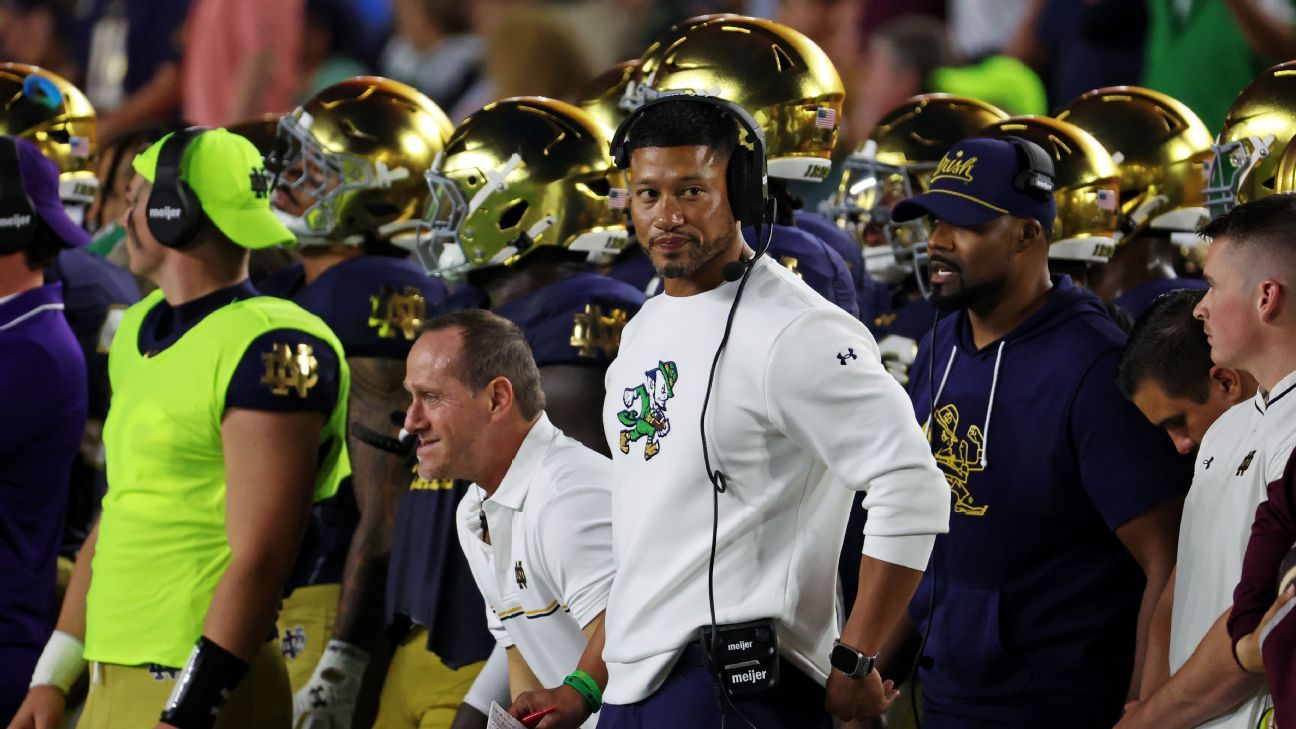
SOUTH BEND, Ind. — Notre Dame athletic director Pete Bevacqua is aware of potential NFL interest in coach Marcus Freeman but will push to retain Freeman and make him one of college football’s highest-paid coaches.
Freeman is 43-12 as Notre Dame’s coach, and he led the team to the national title game last season. Notre Dame completed its season at 10-2 and opted out of a bowl invitation after being snubbed for the College Football Playoff. Although Freeman, 39, has never coached in the NFL, industry sources expect him to be on the radar for the New York Giants and other potential openings.
“Everybody has eyes on Marcus,” Bevacqua said. “College has eyes on Marcus; NFL has eyes on Marcus. I bet Hollywood has eyes on Marcus. … He’s the absolute best coach in the country for Notre Dame, full stop, one of the greatest college coaches in the country.”
Last December, Freeman agreed to a four-year contract extension through the 2030 season. Notre Dame doesn’t release salary information, but Freeman earned more than $7.4 million in 2023, federal tax documents show.
Bevacqua, who did not hire Freeman and took over for Jack Swarbrick as athletic director in March 2024, said one of his primary obligations is to ensure Freeman feels valued at Notre Dame.
“I can say with 100% certainty he feels that way, and Notre Dame is totally aligned around the importance of college football for Notre Dame,” Bevacqua said. “… I make sure that he knows that he will be where he deserves to be, and that is at the top, top, top tier of college football coaches when it comes to compensation every year.”
Bevacqua added that Freeman’s contract will be revised annually to ensure his position among the sport’s highest-paid coaches. He also expects the CFB snub to provide added incentive for Freeman in 2026.
“He won’t forget,” Bevacqua said. “He has a long memory. This will be motivation for him, that’s for sure.”

-
Andrea Adelson
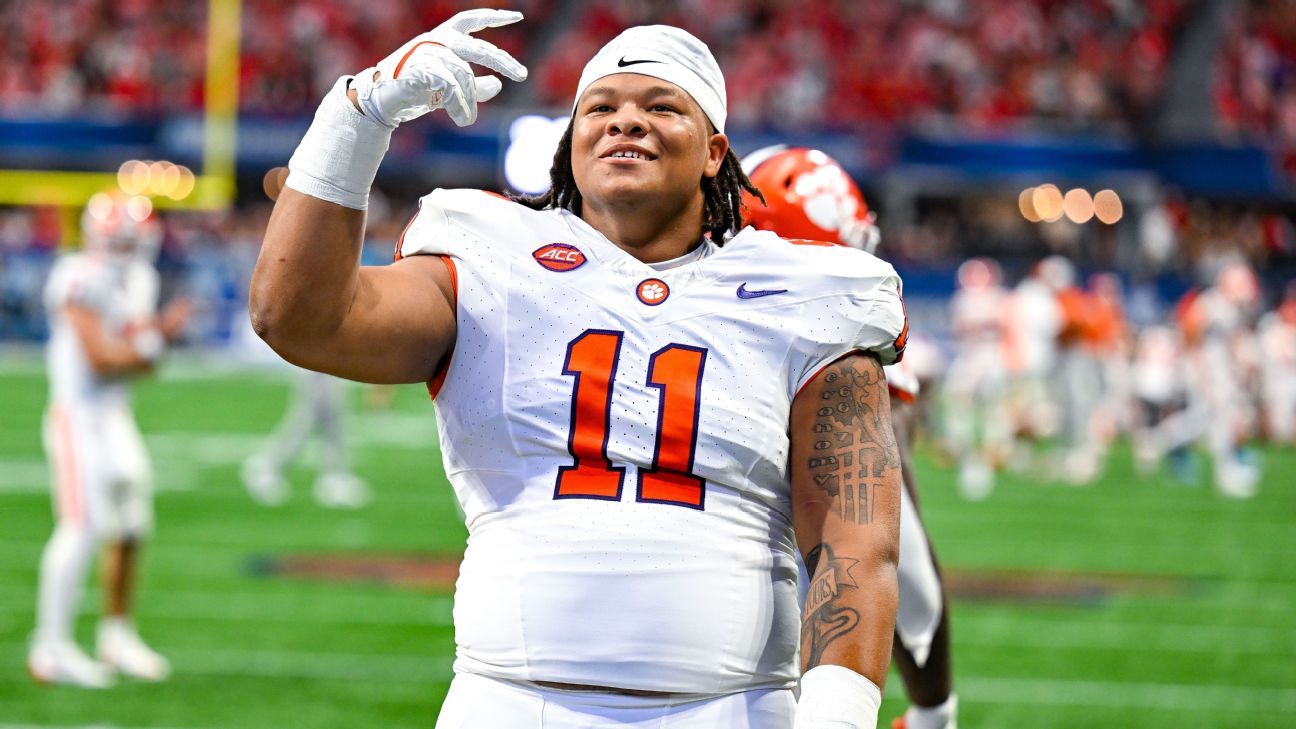
Clemson defensive tackle Peter Woods declared for the NFL draft on Tuesday.
The No. 1-ranked defensive tackle and No. 13 overall ranked player on Mel Kiper Jr.’s 2026 Big Board rankings, Woods was a first-team All-ACC selection this year, with 30 tackles, 3.5 tackles for loss and two sacks.
In a post on social media making the announcement, Woods thanked his family, friends, teammates and coaches. “It has been an honor to wear the paw these last few years, and it will always be a part of me, but the time has finally come.”
Thank You Clemson Family 🧡. pic.twitter.com/ibamSl7xtq
— Peter Woods (@35Pwoo) December 9, 2025
In three years at Clemson, the 6-foot-3, 310-pound Woods made his presence felt — earning FWAA Freshman All-America honors in 2023, then splitting time between tackle and end last season, showing off his versatility. He also scored two rushing touchdowns this past season when he lined up in goal-line packages.
-
 Sports2 years ago
Story injured on diving stop, exits Red Sox game
-
 Sports3 years ago
‘Storybook stuff’: Inside the night Bryce Harper sent the Phillies to the World Series
-
 Sports2 years ago
Game 1 of WS least-watched in recorded history
-
 Sports3 years ago
Button battles heat exhaustion in NASCAR debut
-
 Sports3 years ago
MLB Rank 2023: Ranking baseball’s top 100 players
-
Sports4 years ago
Team Europe easily wins 4th straight Laver Cup
-
 Environment3 years ago
Japan and South Korea have a lot at stake in a free and open South China Sea
-
 Environment1 year ago
Here are the best electric bikes you can buy at every price level in October 2024